Catalog
Blog
Rolex Sky-Dweller Replica — Every Reference Explained
The most complicated watch Rolex makes in series, and the one nobody can explain in a sentence.
A month calendar hidden in the hour markers, a bezel that turns to change what the crown does, and a reference number that tells you the metal and the bracelet if you know how to read it. This guide covers the Sky-Dweller replica the way we would explain it across a counter: what the complications are, what the six digits mean, and which of our 33 listings suits which wrist.
The Sky-Dweller sells slowly and gets recommended quietly. It is not the watch people buy first, and owners tend to keep it. Part of the reason is that it takes ten minutes to understand, which is nine minutes more than a Submariner. So here are the ten minutes.
Every other Rolex sports model does one job. The Submariner reads the time underwater. The GMT-Master reads two time zones. The Daytona times a lap. The Sky-Dweller was built for someone crossing time zones with a calendar to keep track of, and it carries three functions at once: the time where you are, the time where you came from, and the month.
It is also the only Rolex where the bezel is an input device rather than a scale. And it is the only one where the calendar hides in plain sight, because the month is not shown in a window but by a small rectangle beside one of the twelve hour markers. Nobody notices until you point at it, and then they cannot stop looking.
All 33 listings in our Sky-Dweller collection are 42mm, which is the only size the model has ever come in. If you are between collections, the closest alternative in feel is the Datejust 41, and it wears noticeably smaller.
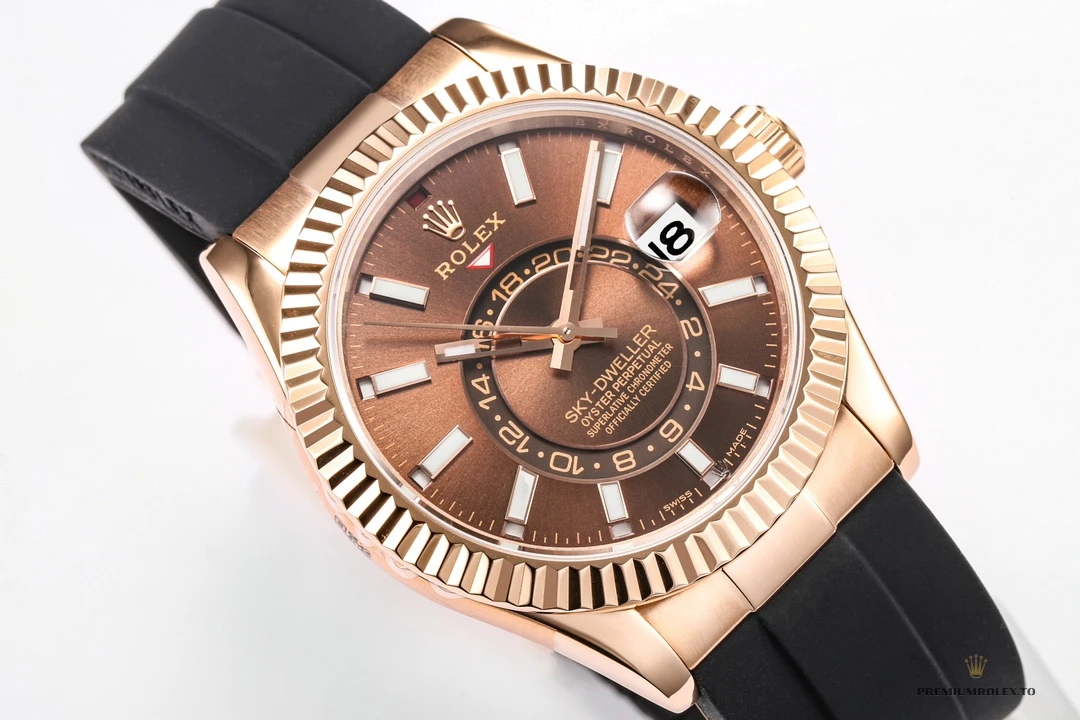
Does the annual calendar work on a Sky-Dweller replica?
Yes. It is a working complication on the Sky-Dwellers we list. The month marker moves with the months, the date at three knows which months are short, and the bezel sets all of it the way the original is set.
The one date left to you is the first of March. No annual calendar tracks February on its own, and the original behaves the same way.
What we check per unit is the feel rather than the function: whether the bezel drops cleanly into each of its three positions, and whether the month marker sits centred against its hour marker. Both show in the photos and the video of your own watch, and nothing ships until you approve them. Ask for the month set to the current one, so you are looking at the position you will actually use.
The annual calendar, and the twelve little windows
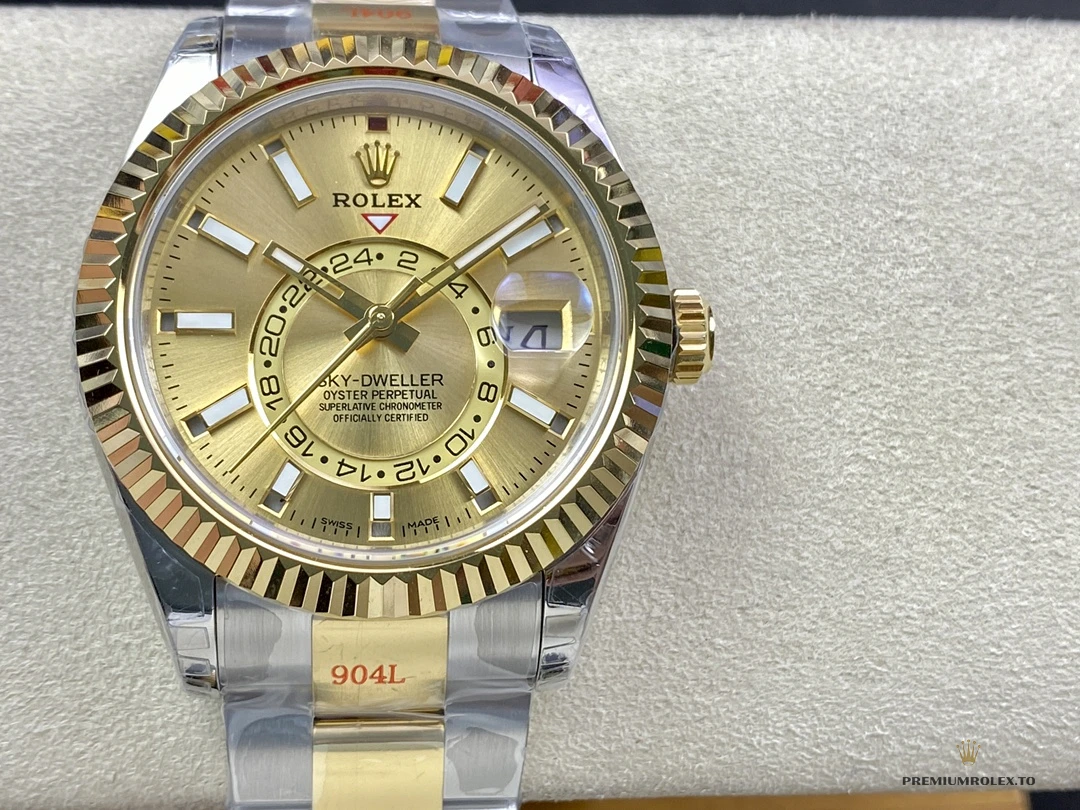
Look at the dial and count the rectangles around the outside of the chapter ring. There are twelve, one beside each hour marker, and eleven of them are the same colour as the dial. The twelfth is filled in. That filled rectangle is the month: at the three marker it is March, at the nine marker it is September.
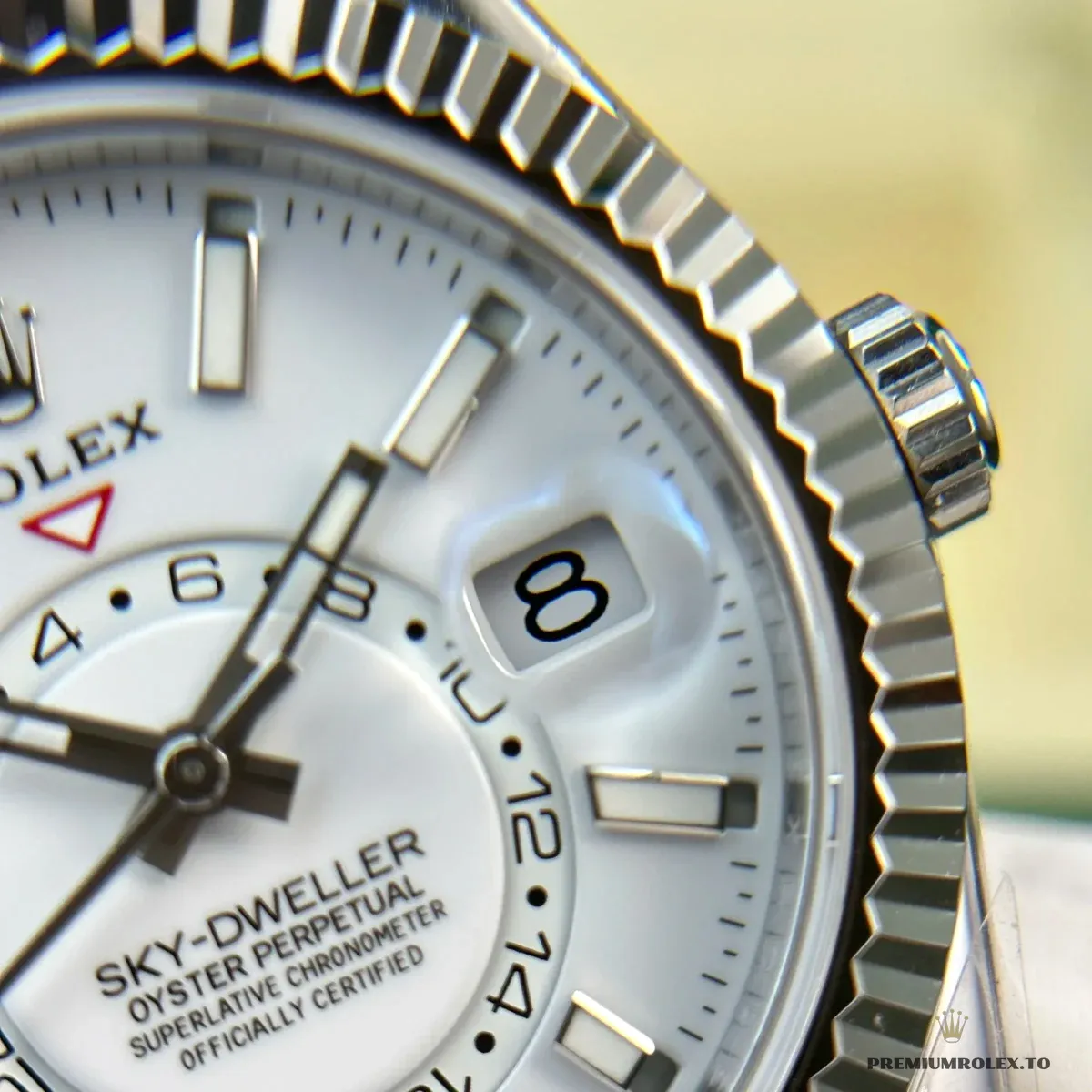
Underneath, the mechanism knows which months have thirty days and which have thirty-one, so the date at three o’clock rolls over correctly at the end of April, June, September and November without help. Rolex calls the system Saros, after the astronomical cycle. The one thing it does not know about is February, because a mechanism that handles leap years is a different and much more expensive proposition. So the date needs setting by hand once a year, at the start of March.
That is the whole of what an annual calendar is: a date that looks after itself eleven times out of twelve. It sounds small until you have owned a watch you correct on the first of every second month.
Reading the dial: off-centre 24-hour disc = the time back home. Filled rectangle on the chapter ring = the month. Window at three = the date. Central hands = local time.
The Ring Command bezel
On a Submariner the bezel counts elapsed minutes. On a Sky-Dweller it does nothing to the dial and everything to the crown. It is a fluted ring that rotates in both directions through three detents, and the position it sits in decides what happens when you unscrew the crown and turn it.
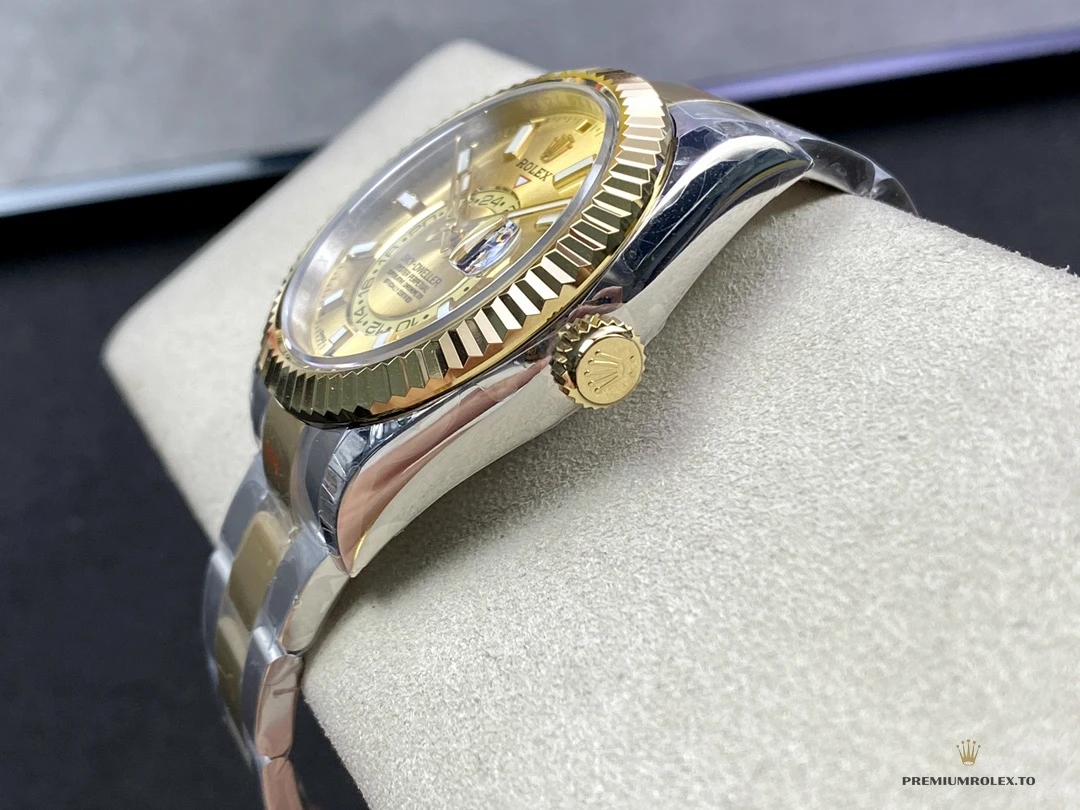
One position sets the local hour hand in one-hour jumps, which is what you use when you land. The next sets the reference time on the off-centre disc. The third sets the date. The dial does not tell you which mode you are in, so the routine is: unscrew the crown, click the bezel to the position you want, turn, click back, screw the crown down. It takes a week to stop thinking about it and then it is faster than any pusher-based calendar.
Two practical notes. The bezel should turn with an even, damped resistance and land in each detent without slop; a gritty or vague action is the first thing to flag in QC photos, and it is easier to see in a short clip than a still. And the flutes are what catch the light on this watch, so the quality of their machining does more for the wrist presence than the dial colour does.
The bezel and the calendar it drives are working functions on the Sky-Dwellers we list. If you want anything else confirmed about one listing, ask in the chat with it open and you get a straight answer about that unit.
326 or 336: which generation are you looking at
The Sky-Dweller arrived in 2012 as the 326 series and was reworked in 2023 into the 336 series. Both are 42mm and both carry the same complications, so the differences are in the details:
If you want the current look, go 336. If you want a Sky-Dweller that reads a little more formal and a little more of its era, the 326 pieces are the ones to scroll for. The 326138 on a brown leather strap is the most old-school configuration in the collection and the least likely to be recognised as a Sky-Dweller at all.
The reference number, decoded digit by digit
This is the most useful thing on the page and almost nobody explains it. A Sky-Dweller reference has six digits and the last three carry all the information.
Take 336934. The first three digits, 336, are the generation. The fourth digit is what the watch is worn on. The last two digits are the metal.
Two minutes with that table and you can read any Sky-Dweller listing on any site without looking at the photos. One point of honesty about the metal: on the watches we sell, every gold tone is a plated finish over steel, not a precious metal body. The reference digits describe the look the piece is built to, not its material composition.
Oyster, Jubilee or rubber
The bracelet changes this watch more than the dial does, and all three options are in the collection.
Oyster. Three flat links, brushed outers, the widest and most sporting of the three. It balances the 42mm case better than the other two and it is the safest choice if this is your only large watch. The 336934 with the white dial on Oyster is the quietest configuration in the whole collection: from two metres it reads as a plain steel sports watch and the complications only appear when someone leans in.
Jubilee. Five links, polished centre rows, dressier and softer on the wrist. It makes the case look smaller and the watch look more expensive, and it is the one to pick if the Sky-Dweller is going to work with a jacket. The mint green dial on Jubilee is the most distinctive thing in the collection and the hardest to photograph, because the green shifts from grey-mint to bright depending on the light.
Rubber. Rolex’s version has a flexible metal blade moulded inside the rubber, which is why it holds its shape instead of flopping. It is the most comfortable of the three in heat and the most casual to look at. The 336239 on rubber is the configuration people ask for most often in the chat.
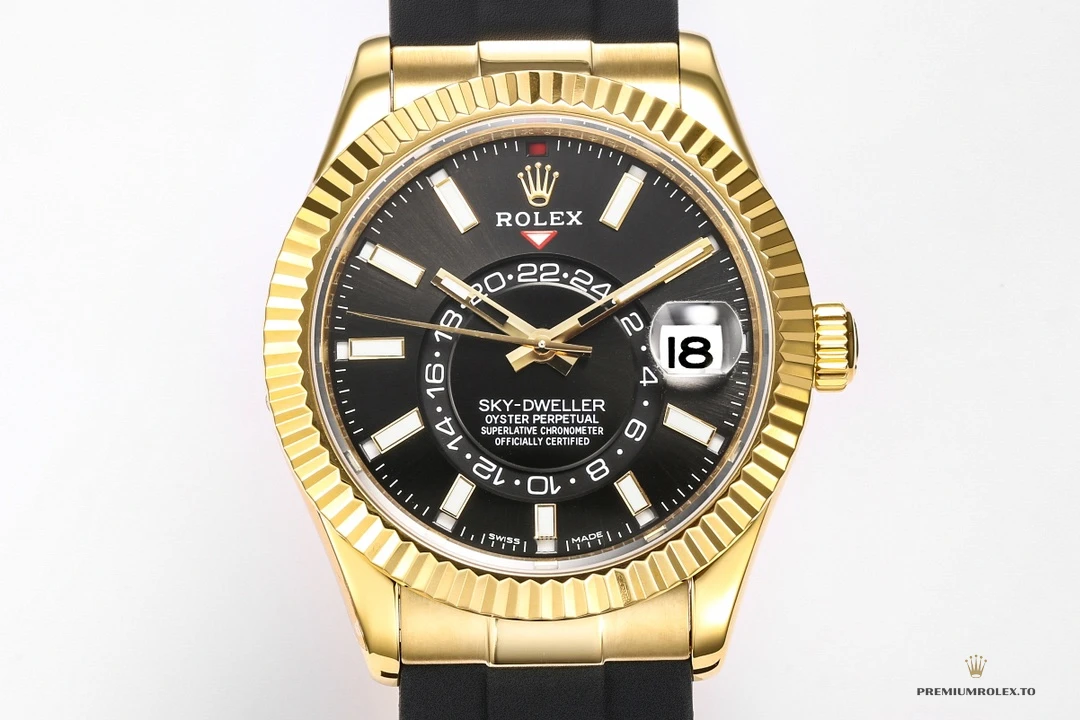
If you want to see all three side by side before deciding, the collection has a full-range listing for each bracelet type: Oyster, Jubilee and rubber.
42mm on a real wrist
42mm sounds large and wears smaller than the number suggests, because the fluted bezel eats into the visual diameter and the dial reads as a smaller circle inside a ring. It is still a big watch. Under a 17cm wrist the lugs will reach the edges and you will feel it under a shirt cuff.
Our rule of thumb, from the size guide: over 18cm the Sky-Dweller is straightforward. Between 17 and 18cm it works if you like a watch that fills the wrist, and the Jubilee helps by breaking up the mass. Under 16.5cm, look at a 36 or 41mm Datejust or Day-Date instead and keep the complications for later.
The Oyster and Jubilee bracelets both carry a clasp extension that adds about 5mm without tools, which covers the difference between a cold morning and a hot afternoon.
Dials, and which ones are hard to build
The dial on a Sky-Dweller has to do more work than on any other Rolex: a rectangle for every month, an off-centre disc, applied markers and a date window, all without looking cluttered. That makes the print quality the thing to look at first.
The easy dials are the flat ones: intense white, bright black. Nothing shifts, so nothing can be the wrong shade, and what remains is print crispness and marker alignment. The champagne dial sits in the middle: it needs the right warmth without going brassy.
The hard ones are the sunbursts and the greens. A sunburst has to sweep evenly from the centre out, and any unevenness shows as a bright patch that follows your wrist as you turn it. The bright blue 326934 and the chocolate on the rose-gold-tone 336235 are the two to look at most carefully in your photos, and also the two that get the strongest reaction on the wrist.
Movement options, and what the case gives you
Every Sky-Dweller listing in the collection offers two movement options on the product page. The Swiss option follows the original architecture and runs at 28,800 vph with about 70 hours of power reserve. The Japanese option is a Miyota-based automatic at 21,600 vph with about 40 hours, and any local watchmaker can service it. The case and the crystal are identical either way: 904L steel with a sapphire crystal and an anti-reflective coating.
The spec table on each listing gives 30m, and that is the number to plan around rather than whatever the original reference was capable of. Rain, hand washing and a caught shower are fine. The pool, the sea and the shower are not. Keep the crown screwed down out of habit, because on this watch the crown is also the calendar and you will be unscrewing it more often than on a Submariner.
For how the movement families differ in detail, the movement guide is the place to go. It also explains why a calendar complication is a harder engineering problem than a plain date window.
What to check in your QC photos
You get eight to twelve photos and a video of your own watch within three to five business days of paying, and nothing ships until you approve them. On a Sky-Dweller, five things are worth more attention than on a simpler model:
Month marker alignment. The filled rectangle should sit centred against its hour marker, not drifting towards the neighbour. Ask for the month set to the current one so you can check the position you will actually look at.
The 24-hour disc. The numerals on the off-centre disc should be evenly spaced and the disc should be flush, not sitting proud of the dial surface.
Bezel action on video. Ask for a short clip of the bezel turning through its positions. A photo cannot show you whether it is gritty.
Date centring. Set to 28, because that is where a font that is slightly too wide shows itself first.
Bracelet end links. On a 42mm case any gap between the end link and the case shows immediately. Ask for a straight-down shot of the lug area.
If something looks wrong, say so at that point and the team pulls another unit. That is the whole purpose of the step, and it costs you nothing but a day or two.
Sky-Dweller, Datejust or Day-Date
These three cover the same territory from different angles, and people who land on the Sky-Dweller usually looked at the other two first.
The Datejust is the default. 36 or 41mm, a date, and the widest choice of dials and bracelets of anything Rolex makes. If you want one watch that never looks out of place, that is the answer and the Datejust guide covers the 36 against 41 decision.
The Day-Date is the dress statement: day spelled out at twelve, date at three, a President bracelet and a gold tone almost always. Our Day-Date guide goes through the references.
The Sky-Dweller is the one for someone who already owns a simple watch and wants something with a mechanism to explain. It is the least obvious Rolex in a room full of them, which for a certain kind of buyer is the entire appeal.
Common questions
How often do I have to set the date by hand?
Once a year, at the start of March. The mechanism carries the date through the end of April, June, September and November on its own, so those four months look after themselves. February is the only one it cannot work out, which is what makes this an annual calendar and not a perpetual one.
What size is the Sky-Dweller?
42mm, and only 42mm. There has never been a smaller version. On a wrist under 16.5cm it will overhang, which is why we point smaller wrists towards a 36 or 41mm Datejust instead.
Which reference should I start with?
The steel-and-white-gold-tone 336934 with a white dial on an Oyster bracelet, if you want the version that draws the least attention. The rose-gold-tone 336235 on rubber if you want the opposite. Both are in the collection.
Is the gold on a Sky-Dweller real gold?
No. Every gold-tone piece we sell is steel with a plated finish. We say that in the chat, on request and here, because the reference digits describe the original’s material and it would be easy to let that imply something about ours.
Can I swap the bracelet later?
Between the metal bracelets, usually yes with the right end links, and any watchmaker can do it. Going from metal to the rubber strap is more involved because the strap fits differently at the lugs. If you think you might want both, buy the configuration you will wear most and ask us before you order the other.
How do I set it after it has stopped?
Wind the crown about twenty turns first so the movement has energy, then unscrew, click the bezel to the date position and set the date, then the reference time, then the local hour. Screw the crown back down when you are finished. Doing it in that order saves going round twice.
Where to look next
Start in the Sky-Dweller collection and filter by what you will actually wear rather than by dial colour: bracelet first, metal tone second, dial third. Then ask us in the chat about the specific listing before you check out, because which batch a listing is on is the one piece of information no product page can keep current.
If the calendar is the part that appeals and 42mm is the part that worries you, the Datejust guide is the better next read.
 WhatsApp Support