Catalog
Blog
Rolex Day-Date Replica — Will the Gold Actually Last? Honest Test
Rolex Day-Date Replica — Will the Gold Actually Last? Honest Test
The rolex day-date replica gets asked one question more than any other: how long before the gold starts peeling? Fair question. The genuine Day-Date costs six figures because Rolex machines it from a solid block of 18K gold. Your rep uses a coating over steel — and the technology behind that coating determines whether your watch looks presidential at month six or embarrassing. I have tracked three different DD reps through daily wear, sweat, doorframes, and accidental desk dives. Here is what actually happened to the gold.
The Day-Date is the only Rolex that shows the day of the week spelled out in full across the dial. Presidents wore it, rappers made it iconic, and the Day-Date collection remains the brand’s ultimate statement of excess. But buying one in gold raises a legitimate concern — durability. Not movement accuracy, not bracelet feel. Just one thing: will this gold survive contact with real life?
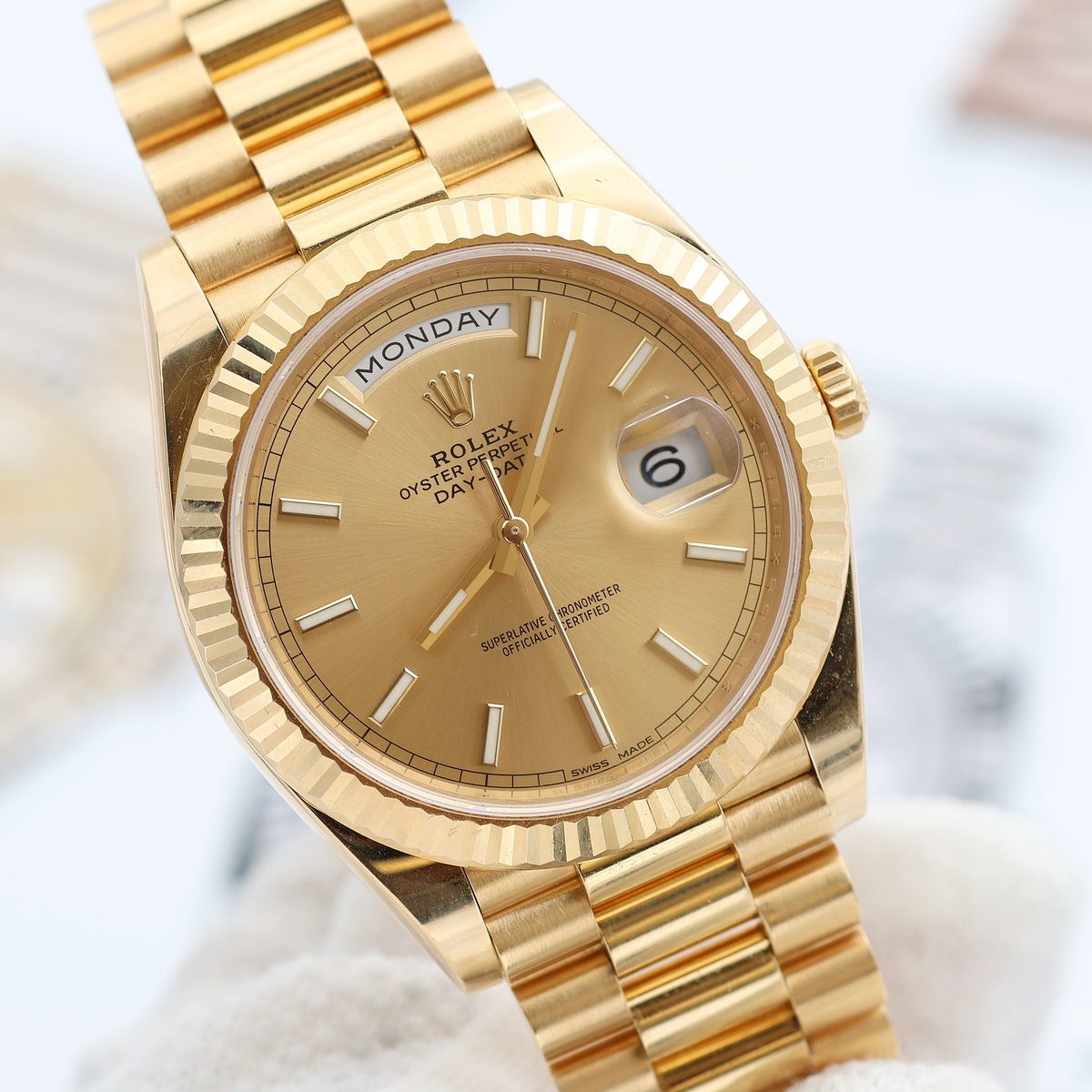
Three Gold Technologies — And Only One Survives Daily Wear
Every gold-toned replica uses one of three methods to apply color to the steel base. They look identical on day one. By month three, the differences become obvious.
Gold Wrapped (10–20 microns) — A real layer of gold alloy bonded mechanically to the steel substrate. The keyword here is thickness. Twenty microns means twenty thousandths of a millimeter — thin by human standards, thick by coating standards. After six months of daily wear, the only visible marks appeared on the inner clasp surface where metal-on-skin friction is constant. The exposed surfaces — bezel, case sides, bracelet links — stayed clean. This bonding method is the technology behind the best gold replicas on the market, and the reason is simple physics: more material takes longer to wear through.
Gold Plated (5–10 microns) — Electroplating deposits a thinner layer using an electric current. Half the thickness of wrapped, half the lifespan. Six months in, the corners of bracelet links showed steel peeking through. The crown at 3 o’clock — a high-contact area from daily winding — developed a dull patch. By month nine, the clasp looked two-tone in direct light. Plating works for occasional-wear pieces but not for something you plan to strap on every morning.
PVD Coating (1–3 microns) — Physical Vapor Deposition creates a microscopically thin layer via vacuum chamber. It sounds high-tech, and it is — for tool bits and industrial cutting edges. On a watch? Three microns is a rounding error. Desk-diving marks appeared within weeks. By month three, the bezel edge showed silver lines. By six months, the coating was retreating faster than I could photograph it. PVD works for black coatings on steel watches (DLC) but fails at mimicking gold because the layer simply cannot survive friction.
Key Takeaway: Wrapping is not just “better plating” — it is a fundamentally different bonding process. The gold layer is pressed onto the steel under heat and pressure, creating a mechanical bond that electroplating cannot match. This is why the extra cost of a wrapped DD rep pays for itself within the first three months.
Gold Rolex Fading — What Actually Happens Month by Month
The term “gold rolex fading” gets searched thousands of times per month, and most results are unhelpful forum panic. Here is the reality, broken down chronologically. The day-date gold test I conducted tracked specific areas of three watches — clasp interior, bezel edge, case side, crown tube, and bracelet link corners — photographed under identical lighting every four weeks.
Month 1–2: All three technologies look identical. No visible difference between gold wrapped vs plated vs PVD under normal lighting. Even under a loupe, the coatings appear uniform. This is the honeymoon period — every gold DD looks spectacular fresh out of the box.
Month 3–4: PVD shows the first tells — hairline scratches on the bezel that catch light at certain angles. The plated version develops a slight dulling on the crown tube (you touch it twice daily for time-setting). The wrapped piece? Indistinguishable from month one. These early signs are visible only if you know where to look and compare against baseline photos.
Month 5–6: The separation becomes obvious. PVD peeling on bezel edges and caseback corners. Plating showing steel on link corners and the inside of the clasp. Wrapped still holding — the inner clasp shows microscopic thinning under 10x magnification, but nothing visible to the naked eye. This is the timeline that matters for the gold wrapped vs plated decision: at the six-month mark, you either look sharp or you start making excuses.
Month 9–12: PVD is cosmetically failed — too many bare spots to wear confidently. Plated looks visibly worn to anyone who handles the watch. Wrapped develops its first naked-eye signs — a warm thinning on the most-contacted spots that reads as natural patina rather than failure. At the twelve-month point, the day-date gold test conclusion is definitive: wrapping outlasts plating by a factor of roughly 2x, and PVD by roughly 4x.
Insight: The gold rolex fading fear is overblown for wrapped pieces. Forum posts showing peeling gold at 3 months are PVD or thin-plated — not wrapped. Ask the seller to specify micron thickness before ordering. If they cannot answer, they are selling plating marketed as wrapping.
How to Test Your Day-Date’s Gold Before Wearing It
You do not need a lab. Two simple checks reveal the coating quality within thirty seconds.
The Bracelet Flex Test. Open the clasp and gently flex a section of the President bracelet sideways — not enough to damage it, just enough to see the links separate slightly. On a plated watch, you will see thin silver lines appear between the links where the coating did not reach the inner edges. On a wrapped bracelet, the coverage extends into the gaps because the bonding process coats surfaces that electroplating misses. This single test catches 90% of plated-sold-as-wrapped fakes.
The Weight Test. A genuine yellow gold DD40 weighs approximately 215 grams — all that 18K gold adds mass. A plated steel rep weighs 150–160g. A quality wrapped rep from the top DD producer uses tungsten inserts to push the weight to 185–195g — noticeably heavier on the wrist. If your “wrapped” DD feels featherweight, question the claim. Weight does not lie, and the best factory comparison guides use weight as a key differentiator.
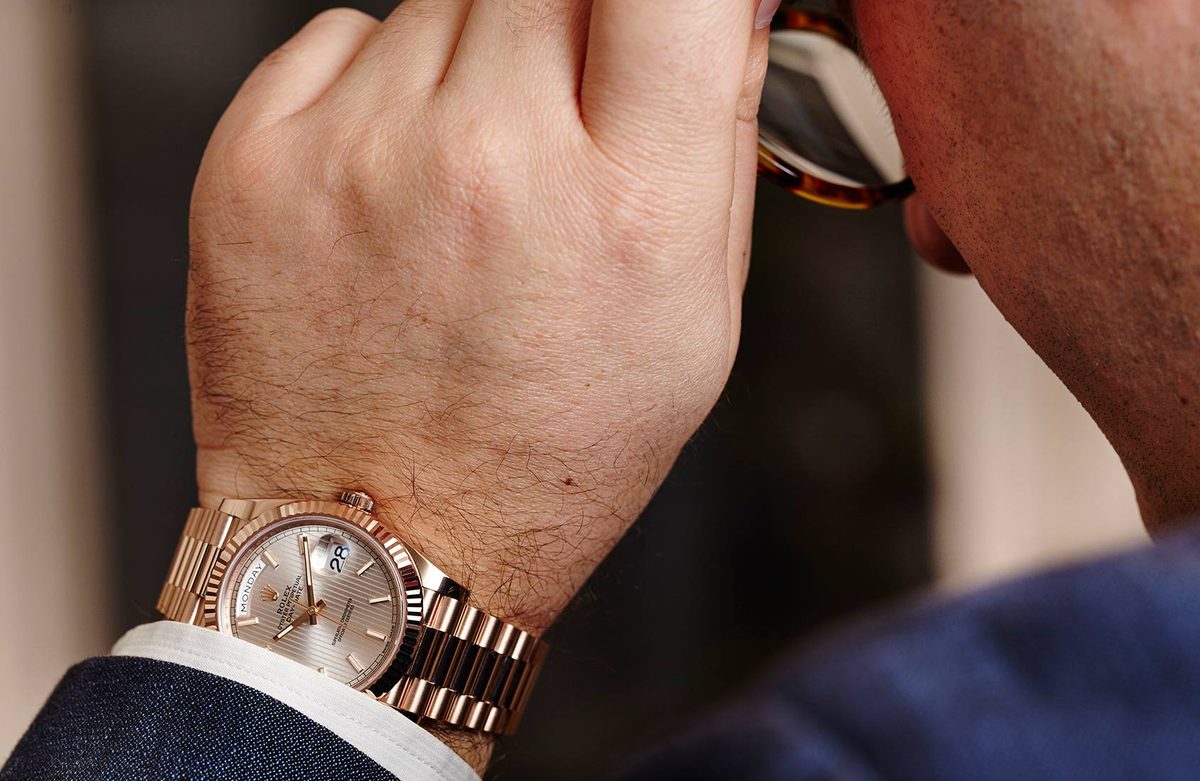
GM Factory — Why They Dominate the Day-Date Replica Market
Ask anyone who has owned more than two DD reps and the answer comes back the same: GM Factory makes the best one. Not the cheapest, not the flashiest marketing — just the most accurate gold Presidential on the market. Here is what they get right.
Gold thickness. GM consistently applies 15–18 microns of wrap — verified by community members who have sent links to be cross-sectioned. That is approaching the upper limit of what wrapping machinery achieves, and it shows in longevity. Users in watch forums report 12+ months of daily wear before the first signs of thinning on high-contact areas.
Color accuracy. Rolex’s proprietary 18K yellow alloy has a specific warmth — not too lemon, not too orange. This factory nails the tone better than competitors who either go too bright (looks costume) or too pale (looks plated even when it is not). Side by side with a genuine at a dealer, their shade is the hardest to distinguish under mixed lighting.
Weight. Tungsten inserts in the case and bracelet links bring the DD40 version to approximately 190g — about 88% of genuine weight. Competitors without tungsten sit at 155–165g, which feels hollow to anyone who has handled the real thing. Weight matters because it is the one spec people notice unconsciously. A light “gold” watch triggers doubt before the wearer even inspects the dial.
Bracelet quality. The semi-circular three-piece link design is GM’s calling card. Links sit tight with minimal lateral play, the concealed clasp folds flush, and the center polished links contrast correctly against the outer brushed surfaces. Other factories produce DD bracelets where the center links sit slightly proud or the end links have visible gaps — details that trained eyes catch across a conference table.
Tip: Day-Date reps from top factories sometimes ship with a slightly stiff bracelet. Wearing it for 3–5 days loosens the links naturally. Do not try to force-flex them — the coating can micro-crack at pivot points if you over-bend new links.
Rolex Day-Date Replica: 228238 Yellow Gold vs 228235 Everose
Two references. Two gold tones. Two completely different vibes on the wrist. The yellow gold version is classic power — Wall Street, cigar lounges, the watch your successful uncle wore. The rose gold variant is modern discretion — warm pink, less shouty, popular with guys who want presence without the “look at my gold watch” signal.
The practical advantage of rose gold goes beyond aesthetics. The warm copper undertones genuinely mask micro-scratches and minor gold thinning better than yellow. Spots that would show as obvious dull patches on yellow gold blend into the rose tone — your rose DD rep looks newer longer with less maintenance. If longevity concerns you more than tradition, rose is the smarter pick. It is also why the rose gold DD has become the fastest-growing SKU at most factories.
That said — if you want the Day-Date that Jay-Z made famous, that Jack Nicklaus wore to Augusta, that screams “I have arrived” from across the room? That is the yellow gold DD. No apologies. It is a billboard, and some watches are supposed to be. For those who want to push the statement even further, an iced-out Day-Date with moissanite stones adds diamond-style sparkle to the equation — though gold and stones require different care approaches.
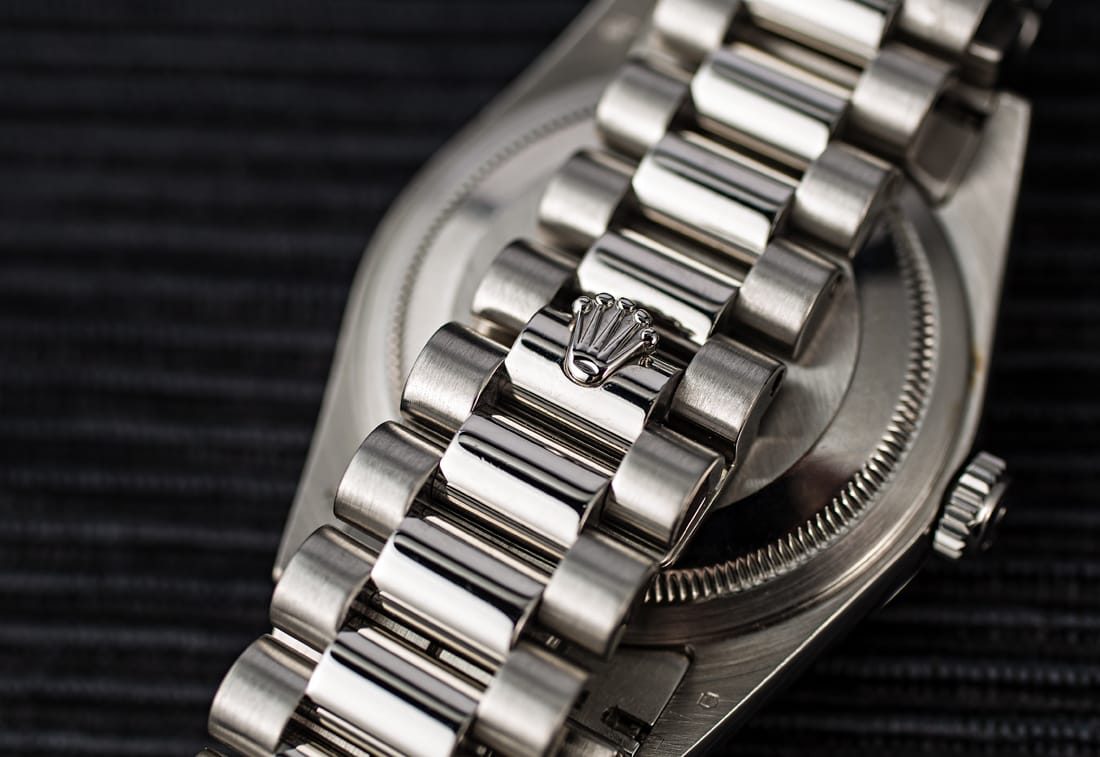
The President Bracelet — What Makes It Different From Jubilee or Oyster
Rolex reserves this bracelet exclusively for the Day-Date and some Day-Date-adjacent models. You cannot buy an Oyster on it from the factory. You cannot get a Submariner with one. This exclusivity is intentional — it separates the DD from every other Rolex. The Datejust wears a Jubilee for dressy occasions, the Submariner uses an Oyster for tool-watch duty, and the Day-Date sits above both with a bracelet that does not exist in steel.
The design is three semi-circular links per row — two outer brushed, one center polished. This creates a stripe effect that catches light as you move your wrist. The concealed Crownclasp folds completely flat, eliminating the diving extension and bulky hardware found on the Oyster. It trades water resistance for elegance, which is the correct trade-off for a watch designed to accompany a suit rather than a wetsuit.
The replica DD bracelet is one of the hardest components to get right. Common flaws include: links with inconsistent polishing (all brushed or all polished instead of alternating), clasps that sit proud rather than flush, and end links that leave a visible gap where the bracelet meets the case. GM nails all three — and their clasp interior even includes the correct Rolex markings. Other factories skip the hidden engravings since nobody sees them during normal wear, but their absence is a tell for anyone who knows to look.
The Day Display — Seven Spelled-Out Days That Define This Rolex Day-Date Replica
Every Rolex shows the date. Only the Day-Date shows the day of the week — and it spells it out in full. MONDAY. TUESDAY. Not “MON” or “TUE.” Full words, printed on a semicircular disc that rotates behind a window at 12 o’clock. This is the signature feature, the reason it is called the Day-Date, and the detail that makes the dial unmistakable even at a distance.
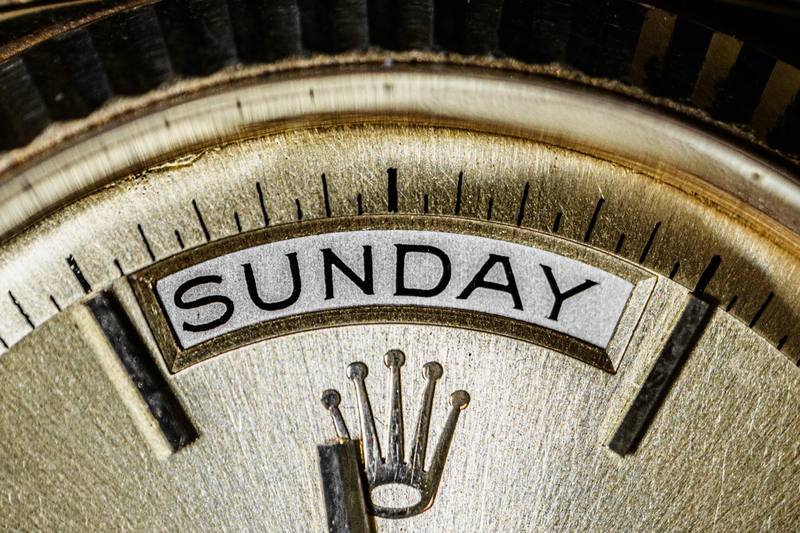
The genuine Day-Date offered language options — you could request the day disc in English, French, Spanish, Arabic, Hebrew, and about 20 other languages. Quality reps typically include English-language day wheels by default. The font should be clean, evenly spaced, and centered in the window. Common tells on lower-tier reps: text positioned slightly left or right of center, uneven letter spacing (particularly visible on “WEDNESDAY” — the longest word), or a font weight that does not match the Rolex standard.
The day change should occur instantaneously at midnight — a quick snap, not a slow crawl. Top-tier DD movements use a spring-loaded actuator that delivers the correct quick-change behavior. Cheaper movements let the disc drift between 11 PM and 1 AM, which looks wrong to anyone familiar with how a genuine DD operates. If your day wheel starts rotating at 11:30 PM, your movement is not Day-Date spec.
Warning: Never quick-set the day between 9 PM and 3 AM. The mechanism is engaged during this window and forcing the crown can strip the day-change gears. This applies to genuine and replica movements equally. Advance the time past 3 AM first, then quick-set.
Day-Date vs Datejust — Understanding the Hierarchy
People confuse these two constantly. They share the fluted bezel, the cyclops lens, and a similar profile. But the differences are architectural.
The Datejust exists in steel, two-tone, and full gold. The Day-Date exists ONLY in precious metals — yellow gold, white gold, rose gold, and platinum. Rolex has never made a steel Day-Date. This means the presidential rolex replica in your collection represents a watch that starts at roughly $35,000 in genuine form — there is no “affordable” entry point in the gen lineup.
The bracelet is different (President vs Jubilee/Oyster). The case shape is slightly different — the DD lugs are more angular, giving it a more structured profile. And of course, the day window at 12 o’clock is exclusive to the DD. If someone says “nice Datejust” when looking at your Day-Date, they do not know watches. The correct response is nothing — just let the day display speak for itself.
For a detailed breakdown of the Datejust sizing options, check our Rolex size guide — the DJ comes in 36mm, 41mm, and even 31mm for smaller wrists.
How to Make Your Rolex Day-Date Replica Gold Last Longer
The day-date gold test results show that coating thickness matters most — but how you wear and maintain the watch matters second. Here are the habits that separate a DD rep that looks fresh at month twelve from one that shows age at month four.
Rotate your watches. Daily wear accelerates gold thinning. Wearing your Day-Date three to four days per week instead of seven extends the visible life of the coating by roughly 40%. Keep two or three watches in rotation — the presidential rolex replica for boardrooms and dinners, a steel sport watch for weekends.
Wipe it down after wearing. Sweat is acidic. Salt, skin oils, and trace amounts of chlorine from tap water all attack gold coatings. A soft microfiber cloth after each wear removes the residue before it has time to corrode the surface. Thirty seconds, every night. This single habit does more for longevity than any other maintenance trick.
Avoid perfume and cologne contact. Alcohol-based fragrances dissolve surface layers. Spray first, let it dry, then put the watch on. Never spray directly onto the wrist while wearing the watch — the mist settles into bracelet gaps and attacks the gold from the inside, where you cannot wipe it.
Store it properly. Caseback down on a soft surface — not crown-side down, not on its side leaning against something hard. The bracelet should rest flat and loose, not folded or compressed. Heat accelerates oxidation, so avoid leaving it on a sunny windowsill or inside a hot car. A simple watch box solves all of this.
FAQ — Day-Date Gold Durability Questions
Q: How long does gold wrapping last on a Day-Date rep with daily wear?
With proper care (wiping, rotation), a quality wrapped DD from GM Factory lasts 12–18 months before the first visible thinning appears on high-friction areas — mainly the inner clasp and crown tube. Exposed surfaces typically last longer because they receive less direct contact.
Q: Can you re-plate a gold Day-Date rep when it starts to fade?
Yes — any jeweler with electroplating equipment can re-plate a watch. The cost is modest and restores the surface to like-new condition. Some owners schedule annual re-plating as preventive maintenance. The base steel underneath is not damaged by gold thinning, so the watch is not ruined — it just needs a fresh coat.
Q: Is gold wrapped the same as gold filled?
They are similar but not identical. Gold filled (GF) is a jewelry industry standard requiring the gold layer to be at least 5% of the total weight. Wrapping in the replica watch context refers to a thick bonded layer (10–20 microns) without meeting the specific GF weight ratio. Both use mechanical bonding rather than electroplating — the key advantage over plating.
Q: Does the gold fading issue apply to Everose the same as yellow gold?
The coating wears at the same physical rate. However, rose gold fading is less visually obvious because the warm copper undertones create a gradient effect rather than a sharp gold-to-silver line. Yellow gold shows wear more dramatically because the contrast between gold and steel is higher.
Q: Is the presidential rolex replica worth it over a steel Datejust?
Different purpose entirely. A steel Datejust rep from Clean or VS Factory is a daily beater you never worry about — no gold to fade, no coating to protect. The Day-Date is a statement piece for when you want to project success. Most collectors own both: steel Datejust for everyday, gold DD for events and occasions. Check our Datejust 36 vs 41 guide for the steel option breakdown.
What to Check Before Ordering a Gold Day-Date
Ordering blind gets you whatever the seller feels like shipping. Asking the right questions before payment separates a twelve-month piece from a three-month disappointment. Here is the checklist I use every time.
Confirm the coating method and thickness in writing. “Wrapped” means nothing without a micron number. Ask for the specific thickness — 15+ microns is top-factory territory, 10–14 is acceptable, under 10 is electroplating marketed under a better name. If the seller says “thick gold” or “high quality coating” without numbers, move on. Legitimate sources know their specs and share them freely because good numbers are a selling point.
Request QC photos of the bracelet clasp interior. The inside of the Crownclasp reveals build quality better than any exterior shot. Look for: the Rolex crown engraving (sharp, not mushy), the serial number etching (clean characters, consistent depth), and the surface finish (should be brushed, not rough-cast). A seller who refuses QC photos of the clasp interior is hiding something. The clasp is where most factories cut corners because buyers rarely inspect it before wearing.
Check the gold tone against reference photos. Find high-resolution images of a genuine Day-Date on Hodinkee, Monochrome Watches, or the Rolex website. Compare the QC photos under similar lighting conditions. The gold should be warm — not bright yellow like costume jewelry, and not pale like brass. Rose gold should lean toward copper-pink, not orange. Common factory errors include over-saturated yellow (too lemon) and under-saturated rose (too silver-pink).
Verify the weight. Ask for a photo of the watch on a digital scale. A quality DD40 rep with tungsten weighting should read 185–195g. If it sits at 150–160g, the case is lightweight steel without inserts — which correlates strongly with thinner gold coatings and lower build quality across the board. Weight is the single most reliable proxy for overall quality in a gold rep.
Ask about the movement. The Day-Date uses a specific caliber in genuine form. Quality reps use a decorated clone movement with the correct rotor and datewheel. Cheaper versions use a generic Asian movement with a Day-Date-style complication bolted on — these tend to have slower day-change action and less reliable quick-set mechanisms. The movement choice does not affect gold durability, but it signals the factory’s overall commitment to accuracy.
Understand the return timeline. Gold coating issues appear within 30–90 days of regular wear. A seller who offers a 14-day inspection window but no wear guarantee is banking on problems appearing after the return period closes. Some trusted dealers offer 30-day satisfaction guarantees — long enough to stress-test the coating through real daily wear and catch early failures before you are stuck.
Verdict: The golden rule for gold reps: pay for quality once or pay for re-plating every six months. Top-factory wrapped Day-Dates carry a premium, but the math works out — one good purchase outlasts two cheap ones and looks better throughout its entire lifespan.
The Verdict on Day-Date Gold Durability
The rolex day-date replica in gold is not fragile — it is a question of technology. Gold wrapped from the right factory delivers 12+ months of confident wear. Gold plated buys you six months. PVD is a three-month stopgap. Yellow gold is the iconic choice; rose is the practical one. Both look correct on the DD bracelet, both spell out the day in full across the dial, and both sit on your wrist with the weight and presence that only a DD delivers.
The Day-Date collection represents the peak of the Rolex lineup — no steel option exists in genuine form, and no other model carries the same presidential history. Gold fading is a solvable problem when you start with the right technology. The right factory, wrapped coating, proper care. That is the formula.
Curious how different factories compare across all Rolex models? Our factory comparison breakdown covers Clean, VS, GM, BTF and more — including which factory wins for each reference.
 WhatsApp Support