Catalog
Blog
Rolex Cellini Replica — Time, Date, Dual Time, Moonphase
The Rolex nobody thinks of as a Rolex, and the only one with a moon phase.
No fluted Oyster bracelet, no ceramic bezel, no cyclops. A 39mm case on a leather strap, a stepped double bezel and, on one reference, a blue enamel disc showing the phase of the moon. This is a guide to the Cellini replica across all 15 of our listings: the four families, what separates them, and who a Cellini is actually for.
Put a Cellini next to a Submariner and they do not look like the same brand. That is deliberate. The Cellini was Rolex’s classical line, built to the proportions of a traditional wristwatch rather than a tool, and it was the only place in the catalogue where you would find a moon phase or a stepped bezel. Rolex retired the name a few seasons ago and replaced the idea with the Perpetual 1908, which makes the Cellini references a closed set rather than a moving target.
That closed set is part of why it is worth knowing. There are four families, they all share a 39mm case, and once you can tell them apart you can read any Cellini listing at a glance. All 15 of ours sit in the Cellini collection.
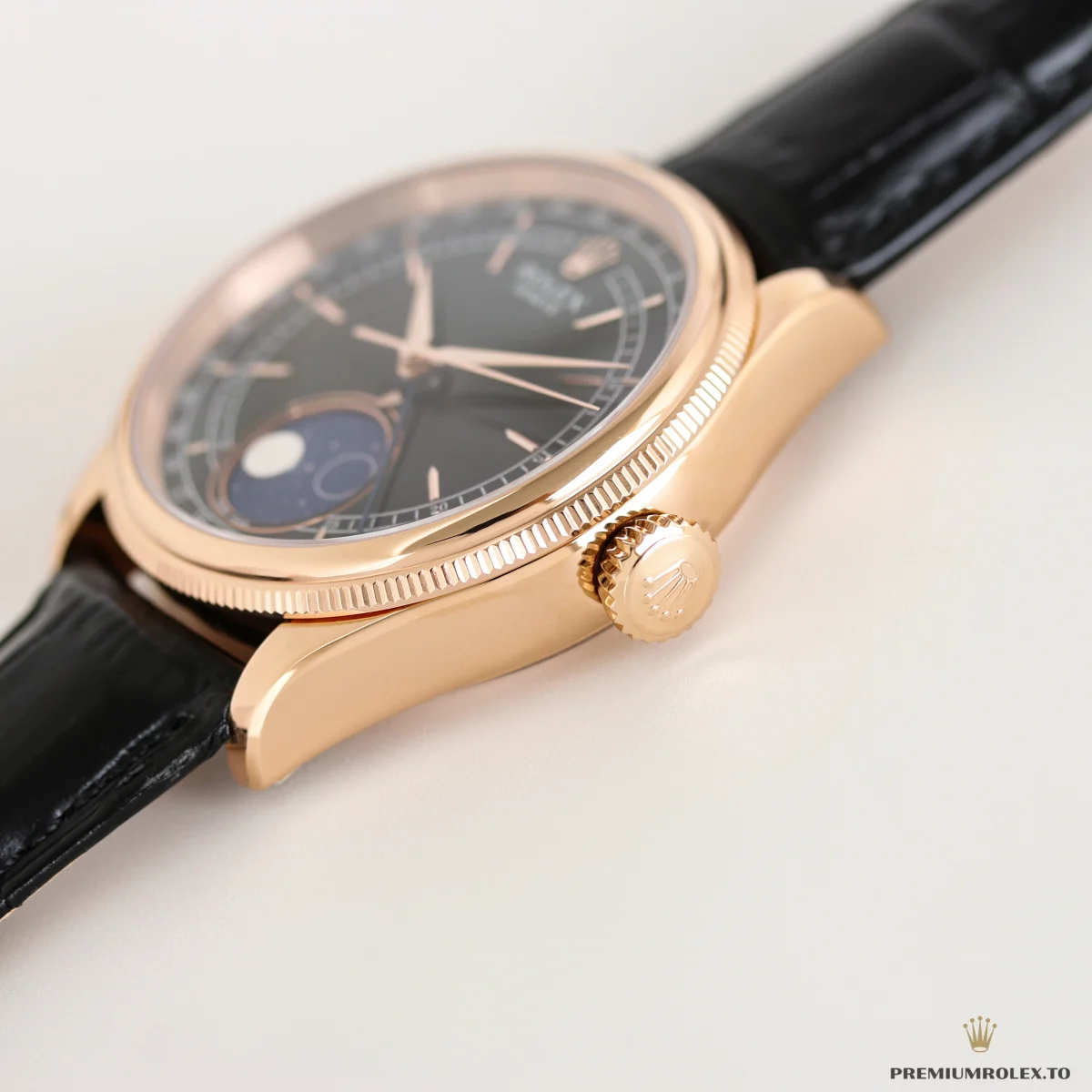
Does the moon phase work on a Cellini replica?
Yes. On both Cellini Moonphase 50535 listings the moon phase is a working complication.
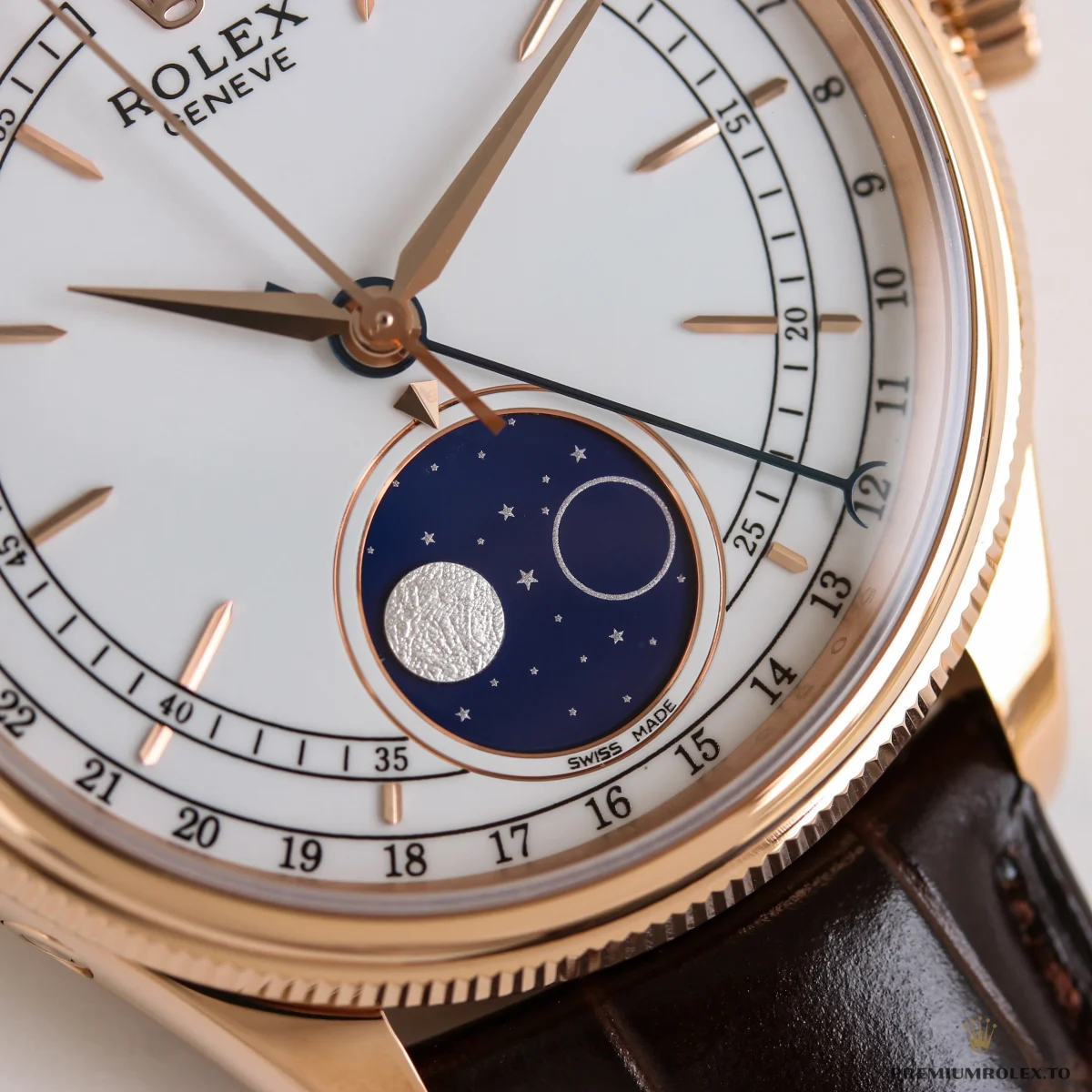
What we check on each unit is the alignment: the moon should sit centred in its aperture, and the date pointer should land on a number, not between two. Both show in the photos and the video of your own watch, and nothing ships until you approve them. Ask for the moon set to the current phase, so you see the position you will actually wear.
Where the Cellini sits, and why it ended
Every other Rolex collection descends from the Oyster: a screw-down case, a metal bracelet, a bezel with a job. The Cellini descends from the other side of the house, the side that made round gold watches on leather before the sports models took over. The name comes from Benvenuto Cellini, the Florentine goldsmith, and the whole line was an argument that Rolex could do restraint.
Commercially it never worked the way the sports models did. Buyers who want a Rolex usually want a Rolex that looks like one, and the Cellini deliberately did not. Rolex withdrew the collection and the Perpetual 1908 took its place, thinner and plainer again. What that means for you is simple: the references below will not be updated, superseded or reissued, so a Cellini is the one part of the Rolex catalogue where you do not have to ask whether a newer generation is coming.
It also means the Cellini is the quietest way to wear a Rolex. Nobody across a table clocks it. For some buyers that is a drawback and for others it is the entire reason.
The four families in our 15 listings
Every Cellini reference we list begins with 505. The next two digits tell you which family, and that is the whole navigation system.
Cellini Time
The purest of the four and the hardest to hide behind. With no date and no subdial, everything rests on the print, the applied markers and the shape of the hands. Dauphine hands taper to a point and catch light along a central ridge, so any softness in the polishing shows instantly. The 50509 with the lacquered black dial is the most severe version in the collection and the one that looks most expensive at a metre. The 50505 in a rose-gold-tone case with a black dial is the warmer alternative.
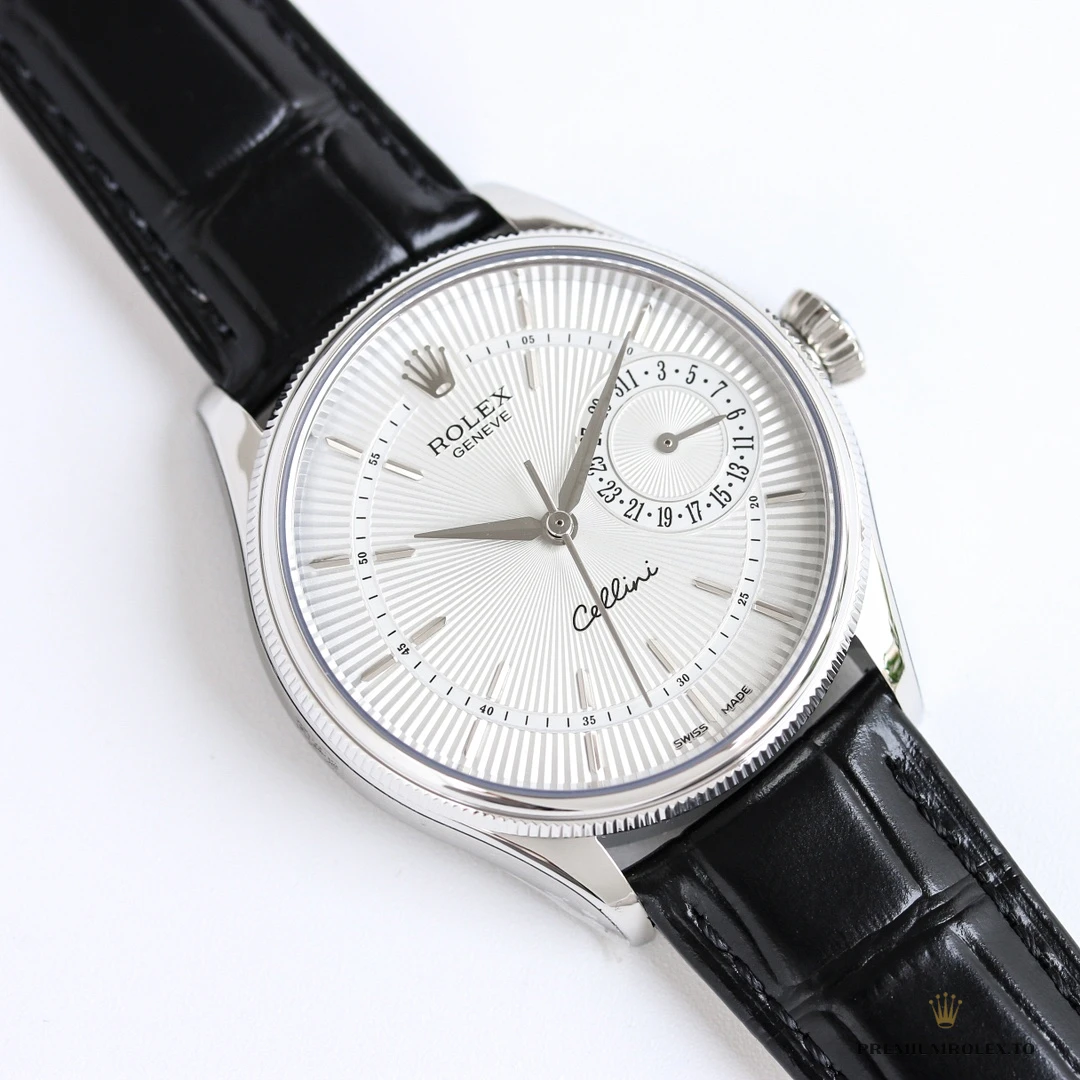
Cellini Date
Rolex’s usual date is a window at three with a magnifying lens over it. The Cellini Date does the opposite: the numbers run around a small ring on the dial and a slim hand points at today. It is quieter, it keeps the dial symmetrical, and it is slower to read, which is a fair summary of the whole collection. The 50519 in white-gold-tone with a black dial is the version in our collection.
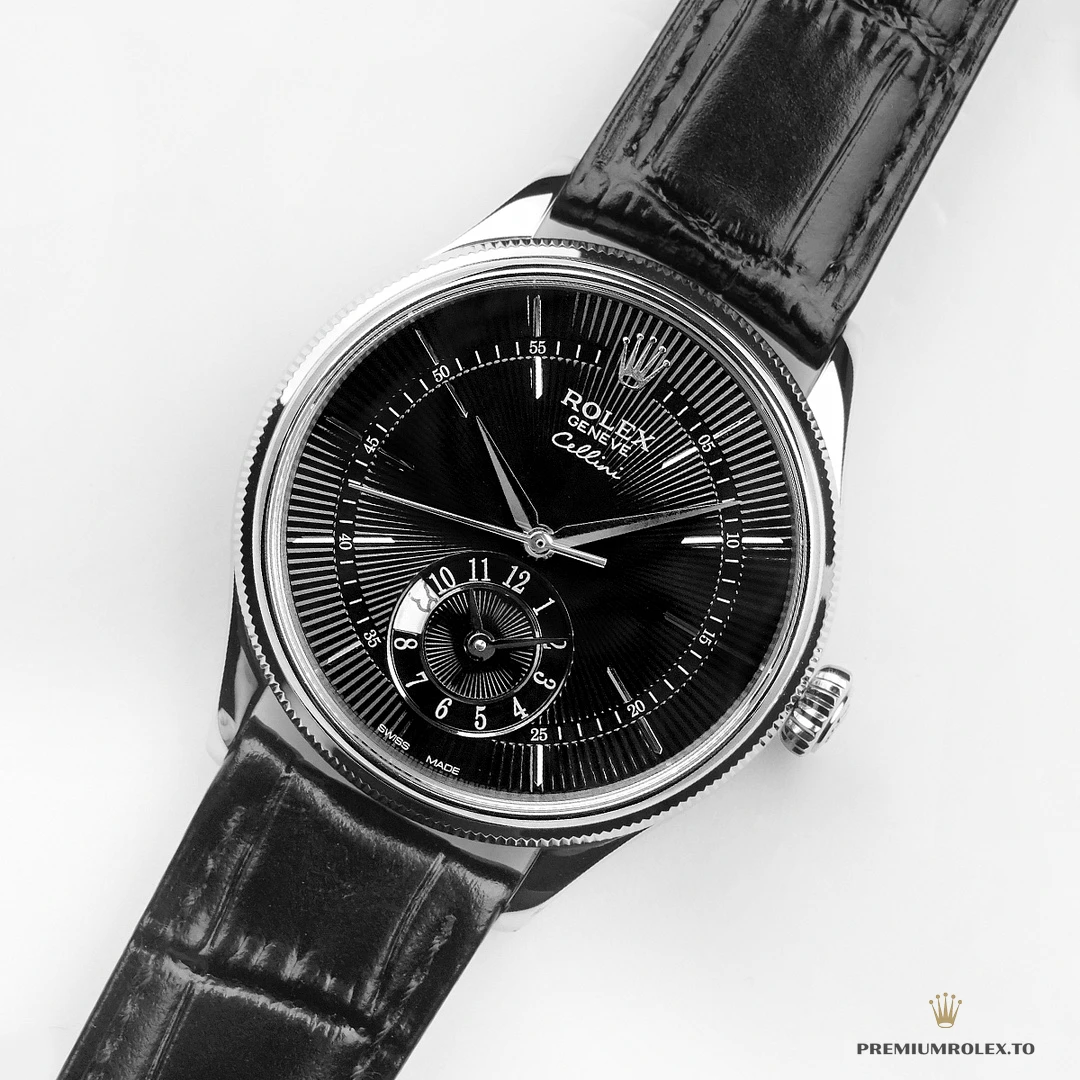
Cellini Dual Time
A second time zone shown in a subdial at six rather than by an extra central hand, with a small aperture that shows a sun or a moon so you know whether it is daytime back home. If you want two zones in something that will go under a cuff, this is the alternative to a GMT-Master, and it is a completely different argument: the GMT shouts, the Cellini does not. The 50529 with a silver guilloche dial is the restrained one, and the 50525 in rose-gold-tone with a brown dial is the warm one.
Cellini Moonphase
The reference people search for by name. At six o’clock sits a small disc of blue enamel carrying a full moon and a new moon, and the phase advances as the month runs. Around the outside of the dial the pointer date tracks the days. It is the only moon phase Rolex has put in a production watch in the modern era, which is why it draws attention out of proportion to its size.
Two versions are in our collection: the white-dial 50535, where the blue enamel disc has maximum contrast and jumps out of the dial, and the black-dial version in rose-gold-tone, where the moon sits deeper and the whole watch reads darker. The white dial photographs better; the black dial wears better at night.
The double bezel, and why it is the hard part
Look at a Cellini from the side and the bezel is two rings, not one: a fluted lower band and a polished domed upper band stepping down onto the crystal. That stepped construction is the collection’s signature and the single most difficult component to reproduce.
Three things have to be right at once. The flutes have to be cut to a consistent depth and angle all the way round, or the light breaks up unevenly as you turn your wrist. The domed upper ring has to be polished without flattening its curve, which is easy to get wrong because polishing removes material exactly where the curve is tightest. And the step between the two has to be a crisp line rather than a rounded transition.
This is where a Cellini separates from a less careful build, and it is not something you can judge from a straight-down product photo. In your QC photos, ask for the watch shot at an angle of about thirty degrees with a single light source, and look at the step line. If it reads as one continuous highlight around the bezel, the machining is good.
One-line test: angle the watch under a lamp. The step between the fluted ring and the domed ring should be a single unbroken line of light, not a series of bright patches.
39mm on the wrist
Every Cellini in our collection is 39mm, which sits neatly between a 36mm Datejust and a 41mm one. On paper it is modest. In practice it wears larger than 39mm suggests, because the dial is wide relative to the case and there is no bezel scale visually shrinking it.
The leather strap changes the arithmetic too. A strap has no mass to balance the case, so the watch sits higher and feels lighter than a bracelet watch of the same diameter. It slides under a cuff more easily than anything on an Oyster bracelet. Against that, a strap needs sizing to your wrist rather than adjusting on the fly, so measure before you order rather than after.
Our size guide has the full wrist-to-case table. The short version for the Cellini: comfortable from about 16.5cm upward, and genuinely elegant between 17 and 18.5cm. Below 16.5cm it will look like a large watch on a small wrist, which is not what this collection is for.
Metals, dials and straps
Two case tones run through the collection: white-gold-tone and rose-gold-tone. To be exact about what that means on the watches we sell, every gold tone is a plated finish over steel, not a precious metal body. We do not describe them any other way, on the product page or here.
The white-gold-tone pieces read as steel from a distance, which suits the severe black and silver dials. The rose-gold-tone pieces are warmer and pair with black, white and brown. If you already own steel sports watches and want something that looks different on the wrist rather than the same watch in another size, the rose-gold-tone Dual Time or Moonphase is the bigger change.
Dial finishes fall into three groups. Lacquered dials, mostly the blacks, are deep and flat with a wet-looking surface. Guilloche dials carry a fine machined pattern that catches light in bands, and the silver ones show it best. Plain white and silver dials rely entirely on print quality and marker alignment, so they are the ones to inspect hardest in photos.
Strap and buckle details differ between listings, so read the individual product page rather than assuming from the family. If the exact strap material on a specific piece matters to you, ask in the chat and we will confirm it for that watch instead of generalising.
Cellini, Datejust or Day-Date
Three ways to wear a classical Rolex, and they are not interchangeable.
The Datejust is the one that does everything. 36 or 41mm, a bracelet, a date window, and 81 listings worth of dial and bezel combinations. It is the correct answer if you want one watch for work, weddings and weekends, and the Datejust guide covers the size decision.
The Day-Date is the loud formal option: day spelled out at twelve, a President bracelet, almost always a gold tone. It announces itself. The Day-Date guide runs through the references.
The Cellini is the third road. It is the least recognisable and the most traditional, and it is the only one of the three that will sit comfortably under a French cuff. Buy it second rather than first, and buy it because you want a round watch on leather, not because you want a Rolex people will notice.
Movements and everyday care
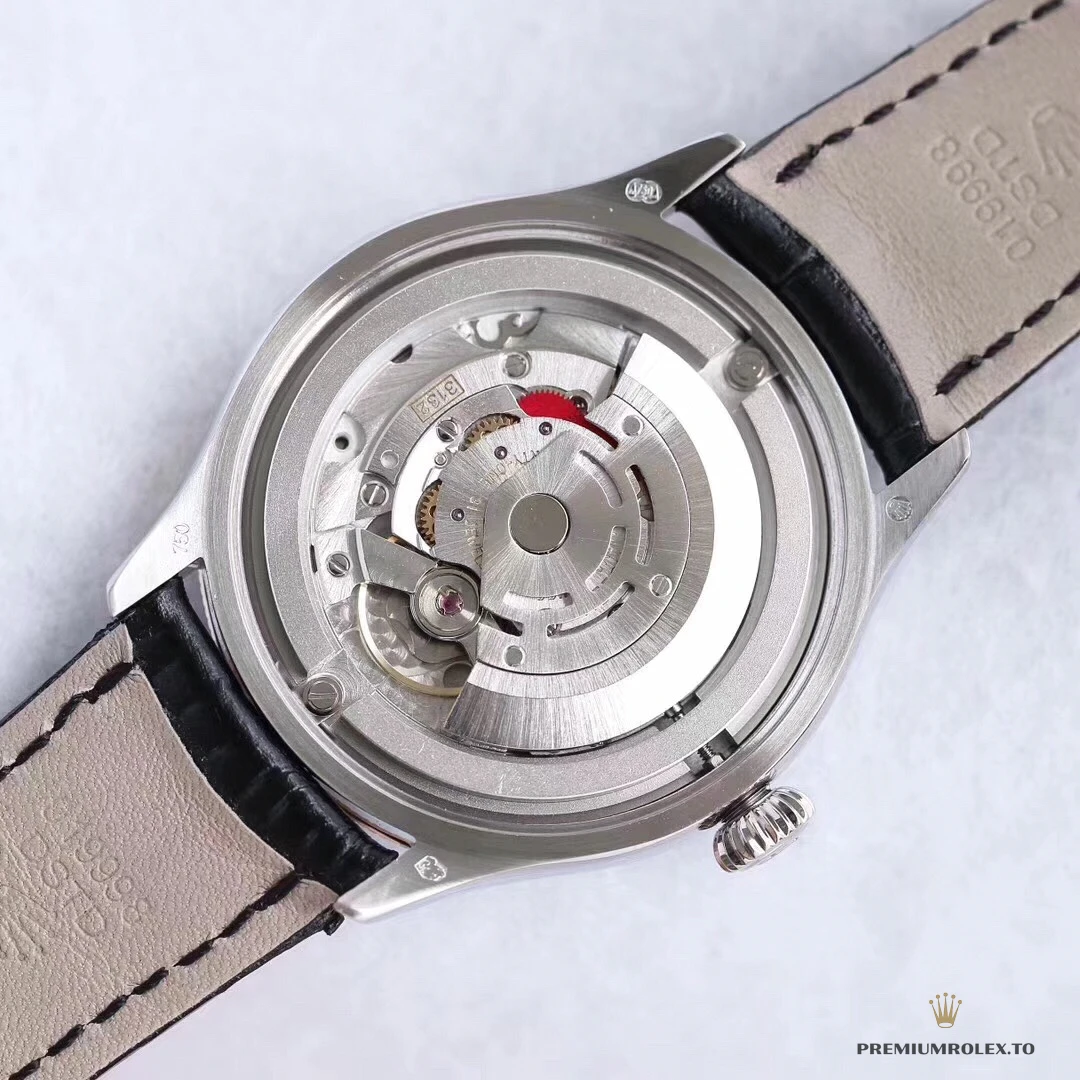
Every Cellini listing offers two movement options on the product page. The Swiss option follows the original architecture and runs at 28,800 vph with about 70 hours of power reserve, so it survives a weekend in a drawer. The Japanese option is a Miyota-based automatic at 21,600 vph with about 40 hours, and any watchmaker anywhere can service it. Case and crystal are the same either way: 904L steel with a sapphire crystal and an anti-reflective coating.
Care is the same as for any of our watches, with one addition for the strap. The spec table on each listing gives 30m, so rain and hand washing are fine and the pool and the shower are not. A leather strap likes that treatment even less than the case does: water darkens and stiffens leather, and sweat does it faster. If the strap gets wet, let it dry flat and away from a radiator.
Beyond that: wipe it down when it comes off, keep it away from magnets, and have it serviced every three to four years. On the Moonphase and the Dual Time, set the complications with the watch fully wound rather than half dead, because the mechanisms need energy to advance cleanly. For how the movement families differ, the movement guide has the detail.
What to check in your QC photos
You get eight to twelve photos and a video of your own watch within three to five business days of paying, and nothing ships until you approve them. On a Cellini the list is different from a sports model, because there is no bezel insert or ceramic to inspect and the whole impression rests on finishing.
The bezel step, at an angle. As above, the single most informative shot on this collection.
Hand polishing. Dauphine hands should show a clean central ridge with an even highlight running its length, not a dull or wavy one.
Marker seating. Applied markers should sit flat against the dial with no visible adhesive and no tilt. On a plain dial this is the first flaw a photograph reveals.
The moon disc, on the Moonphase. Ask for a macro of the enamel. It should be a smooth even blue with a crisp edge to the moon, no pitting and no orange peel texture.
The pointer hand against its ring. On the Date and the Moonphase, the pointer should land centred on a number rather than between two.
Strap and buckle. Stitching should be even and the buckle should close without play. Ask for the buckle shot separately, because it is often missed.
Questions we get about the Cellini
Does the moon phase actually advance?
Yes. The moon phase is a working complication on both 50535 listings. Check the position of the moon in the photos of your own watch before you approve it.
Which Cellini reference should I buy first?
If you want the collection’s character with nothing to explain, the black-dial 50509 Time. If you want the reason people look at the Cellini at all, the white-dial 50535 Moonphase. Both are in the collection.
Is the case really gold?
No. Rose-gold-tone and white-gold-tone Cellinis are steel with a plated finish. We state that plainly because the reference numbers describe the original’s material and it would be easy to let that imply something about ours.
Can I put it on a metal bracelet?
Physically a watchmaker can fit a strap or bracelet with the right lug width, but it fights the design. The Cellini’s lugs and case flanks were drawn for a strap, and a metal bracelet makes the case look thicker and the proportions heavier. If you want a Rolex on a bracelet, start in the Datejust collection instead.
Is the Cellini a good first Rolex?
Usually not, and that is not a criticism of the watch. A first Rolex normally needs to be recognisable and to work with everything, which points at a Datejust or a Submariner. The Cellini is the watch you buy once you already have that covered and you want something with a different silhouette in the box.
Why can I not find many Cellini listings anywhere?
Because the line was retired and it never sold in the volumes the sports models did, so there is less demand and far less tooling attention behind it across the whole market. Fifteen listings is a comparatively deep selection for this collection, not a thin one.
Where to start
Decide the family first, because it changes what the watch is for: Time if you want silence, Date if you want a calendar without a window, Dual Time if you travel, Moonphase if you want the one complication Rolex almost never made. Then pick the case tone, then the dial. Then ask us in the chat about that specific listing before checking out, because the batch question is the one thing a product page cannot keep current.
Browse the 15 Cellini listings, and if the 39mm case is the part you are unsure about, read the size guide first.
 WhatsApp Support