Catalog
Blog
Iced Out Rolex Replica — Moissanite vs CZ: Which Stones Actually Sparkle After 6 Months?
Iced Out Rolex Replica — Moissanite vs CZ: Which Stones Actually Sparkle After 6 Months?
The iced out rolex replica market splits into two camps: moissanite believers and CZ bargain hunters. Both look identical on day one. Both throw fire under nightclub lighting. Both make your wrist the loudest thing in the room. The difference shows up at month three — when one stays brilliant and the other starts clouding like a car windshield in November. I have tracked both stone types through six months of daily wear, UV tests, and the dreaded breath fog test. Here is what survived and what did not.
Iced out watches are not subtle. They exist to be noticed, photographed, and talked about. That means the stones have to perform — not just on unboxing day, but through months of wrist sweat, accidental doorframe contacts, and the everyday friction that separates jewelry-grade gems from costume-grade fillers. The right iced out piece holds its sparkle for years. The wrong one turns milky before you finish paying for it.
Three Stone Types — Honest Comparison After Six Months of Wear
Every iced Rolex rep uses one of three stone types. The marketing material calls them all “diamonds” in some creative way — VVS stones, premium crystals, simulated diamonds. Ignore the branding. What matters is the mineral, the Mohs hardness rating, and how it handles six months on a human wrist.
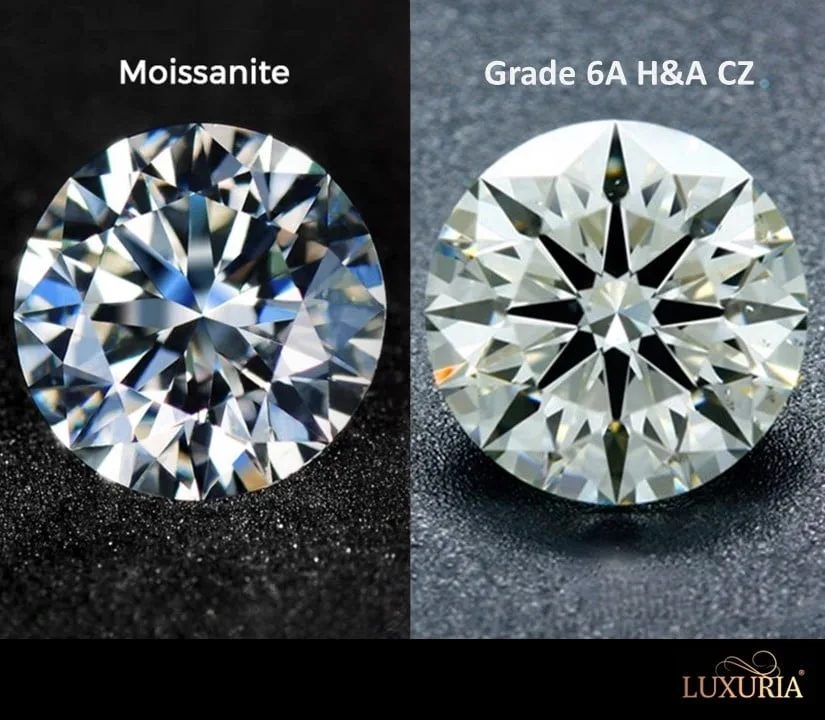
VVS Moissanite (Mohs 9.25) — Silicon carbide, originally discovered in meteor craters. It is the second hardest gemstone used in jewelry after diamond. The “VVS” label borrowed from the diamond grading system means very-very-slightly included — essentially eye-clean. This gem refracts light differently than diamond, producing stronger rainbow fire (the colored flashes that shoot from facets under direct light). After six months of daily wear on a Datejust bust-down, every stone looked identical to day one. No clouding, no scratching, no dull spots. I could not find a single gem that had degraded. Silicon carbide is the premium choice and the only one I recommend for pieces worn more than twice a week.
Cubic Zirconia / CZ (Mohs 8.0–8.5) — Synthetic zirconium dioxide, mass-produced and cheap. CZ looks beautiful out of the box — white, sparkly, clean. The problem begins around month two. Microscopic surface scratches accumulate from normal wear — bumping sleeves, resting on desks, brushing against seatbelts. Each scratch is invisible alone, but together they create a haze that dims the brilliance. By month four, the stones look visibly duller under direct sunlight than they did at unboxing. By month six, the difference next to a fresh CZ stone is embarrassing. CZ works for occasional-wear pieces — a watch you pull out three times a month for events. It does not survive daily rotation.
Lab-Grown Diamond (Mohs 10) — Chemically, physically, and optically identical to mined diamonds. Created using CVD (Chemical Vapor Deposition) or HPHT (High Pressure High Temperature) methods. Nothing scratches a 10 on the Mohs hardness scale except another diamond. These stones will outlast the watch they sit in — twenty years from now they will look exactly the same. The catch: real lab-created stones on a replica are the most expensive option by a significant margin. For a full bust-down Datejust, the stone cost alone can approach or exceed the watch cost. Worth it if you plan to keep the piece for years, overkill if you rotate watches frequently.
Key Takeaway: The moissanite vs CZ rolex debate comes down to one number: 9.25 vs 8.0 on the Mohs scale. That 1.25-point gap represents the difference between a stone that survives your lifestyle and one that surrenders to it. For any iced piece you plan to wear regularly, moissanite is the minimum threshold.
Three Tests to Identify Your Stones Without a Jeweler
You do not need a gemology degree to tell moissanite from CZ. Three simple tests — all doable at home — reveal what is sitting on your bezel.
The Breath Fog Test. Breathe on the stones like you are fogging a mirror. CZ holds the condensation for 2–4 seconds — you will see a visible fog patch. Silicon carbide clears almost instantly because its thermal conductivity disperses heat faster. Diamond clears even faster. This test is not 100% definitive between silicon carbide and diamond, but it reliably separates both from CZ. If your stones stay foggy for more than two seconds, they are cubic zirconia.
The UV Lamp Test. Hold a UV flashlight (available cheaply online) over the stones in a dark room. CZ fluoresces strongly — a bright blue-white glow that is unmistakable. Moissanite shows minimal or no fluorescence. Lab-grown diamonds vary by production method. This test is particularly useful on an iced out piece where individual stones are small — the collective glow of CZ under UV light is dramatic compared to the muted response of premium stones.
The Newspaper Test. Place a loose stone flat-side down on a line of printed text. Look through the top. CZ allows you to read the text through the stone with minimal distortion — its lower refractive index creates a clear window effect. Silicon carbide and diamond scatter the light so aggressively that the text becomes unreadable — just a blur of color and light. This test requires a loose stone, so it works best when evaluating before purchase rather than on a set piece.
Bust Down vs Factory Set — Two Paths to an Iced Out Rolex Replica
There are two ways to get stones on a watch, and the method matters as much as the material.
Bust Down (Custom Set by a Jeweler) — You buy a standard watch, then send it to a jeweler who drills seats and sets stones individually. This is the bust down rolex replica approach, and it produces the best results. A skilled setter examines each surface, plans stone placement for maximum coverage, and uses a microscope to position every gem. The result is tighter stone placement, better symmetry, and more consistent sparkle across the piece. Bust-down work also allows you to choose your stone type — specify the stone type, select the exact size per area, and approve QC photos before the piece ships back.
Factory Set (Stones Applied at the Factory) — The watch arrives already iced. The stones are set during manufacturing using automated or semi-automated processes. Factory-set pieces are cheaper and faster, but quality varies dramatically between producers. Common issues: uneven stone sizes within the same row, visible gaps between stones (especially on curved surfaces like the bezel edge), adhesive residue around settings, and inconsistent prong heights. For a casual piece worn to events, factory set is acceptable. For a daily-wear statement, bust down is worth the extra investment.
Tip: When ordering a bust down rolex replica, ask for before-and-after photos plus a video under direct light. A good setter will film the piece rotating slowly under a lamp — this reveals any dark spots where stones are not catching light due to poor angle or loose seating.
Prong Setting vs Pave Setting — Durability vs Aesthetics
How stones attach to the watch determines how long they stay there. Two dominant methods exist, and each has a clear use case.
Prong setting uses small metal claws (typically 4 or 6 per stone) that grip each gem individually. The prongs are visible between stones, creating small metal accents between the sparkle. This is the traditional method and the most secure — a properly set prong holds through impacts that would dislodge a pave stone. The bezel of a bust down typically uses prongs for the larger stones because they experience the most physical contact. If a prong bends from impact, a jeweler can re-tighten it in minutes without disturbing adjacent stones.
Pave setting (pronounced pah-VAY) uses tiny beads of metal drilled from the surface to hold stones in place. The stones sit nearly flush with the metal, creating a continuous carpet of sparkle with minimal visible metal. It looks incredible — the “fully iced” effect that fills Instagram feeds relies on pave setting across the bracelet links, case sides, and dial. The trade-off: pave stones sit in shallower seats and rely on smaller contact points. A hard impact can pop a pave stone out without warning. Replacements require a jeweler with the right stone size — and on an iced piece with 300+ stones, matching the exact diameter matters.
The best iced out pieces use both methods: prongs on the bezel and lugs (high-impact zones) and pave on the bracelet, case sides, and dial (protected zones). This hybrid approach balances the visual density of pave with the mechanical security of prongs. If you see a piece advertised as “full pave including bezel” — ask about stone retention. Bezel prongs exist for a reason.
Most Popular Iced Out Rolex Replica Models — And Why They Work
Not every Rolex model works equally well as an iced platform. The surface area, case geometry, and bracelet type all affect how stones sit and how the finished piece looks.
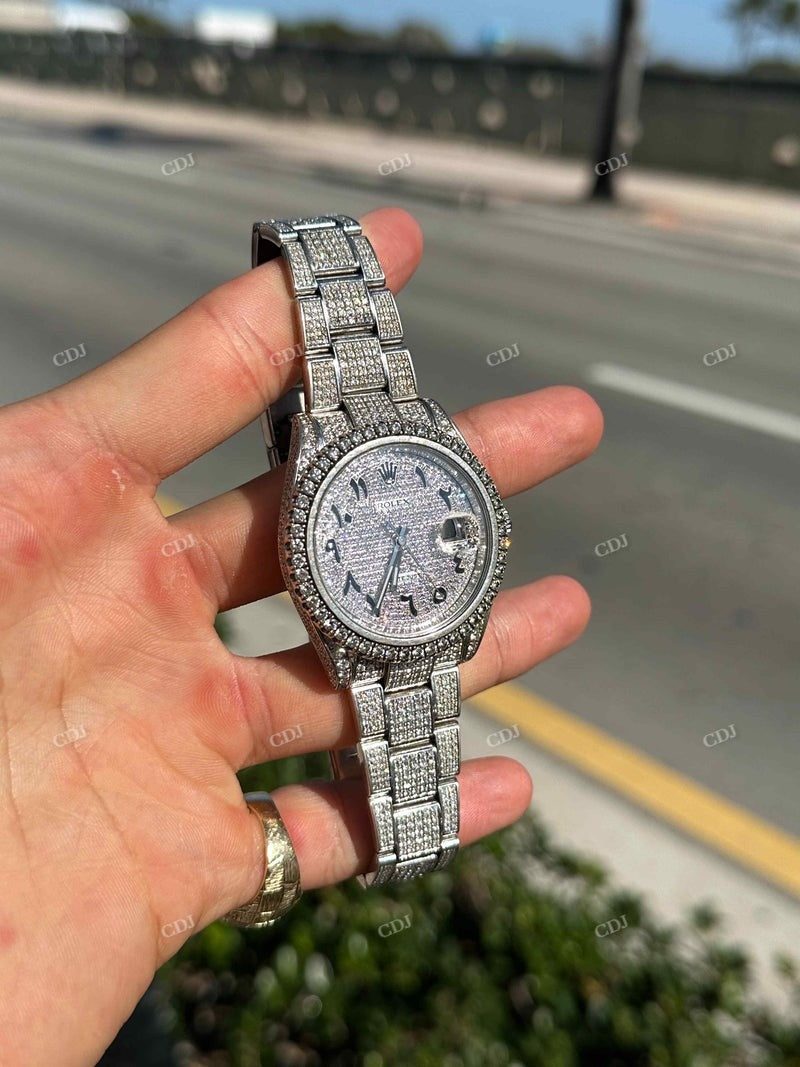
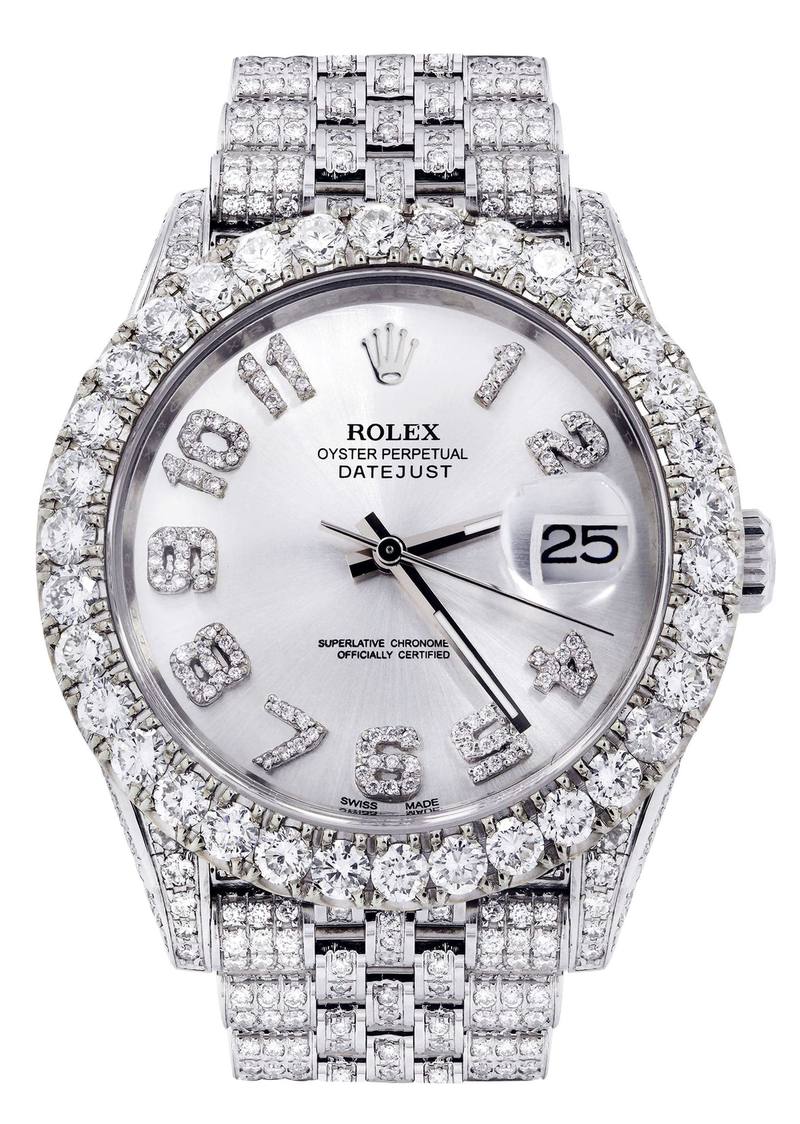
Datejust 41 — The #1 Iced Out Platform. The Datejust dominates the bust down market for practical reasons. The Oyster bracelet has wide, flat links that hold pave stones beautifully. The 41mm case provides enough surface area for a dramatic bezel ring without looking oversized. The fluted bezel — already a textured design — translates perfectly into stone placement. And the steel base means the watch cost stays reasonable, leaving more budget for quality stones. A Datejust 41 bust-down with quality stones is the sweet spot for most buyers.
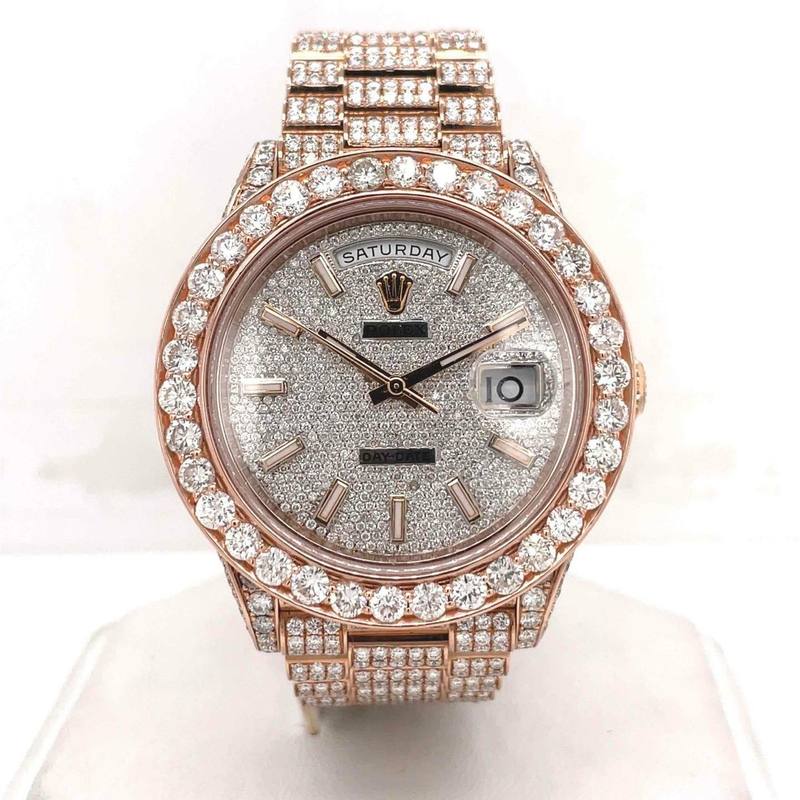
Day-Date Full Pave. The Day-Date in gold with a full pave dial and diamond bezel is the rapper’s choice — the “Presidential” taken to its extreme. The gold base adds warmth underneath the stones, creating a different sparkle character than steel. Rose gold plus white stones creates a particularly striking combination — the warm metal contrasts with the cool brilliance of the stones. Factory set Day-Dates are more common than bust-downs because the gold coating adds complexity to custom setting.
Submariner Diamond Bezel. The Sub with a diamond bezel replacement is the “stealth ice” option. The watch body stays clean — standard black dial, standard bracelet. Only the bezel gets stones. It reads as a sport watch from across the room and only reveals the ice up close. This is the choice for guys who want sparkle without the “I own an ice rink” vibe. A stone-set bezel on a Sub rep adds presence without sacrificing the tool-watch aesthetic.
How to Keep Your Iced Out Piece Sparkling
Stones stay brilliant only if you clean them. Body oil, soap residue, and dust collect in the gaps between settings — and that film kills sparkle faster than surface scratches do. Here is the maintenance routine that keeps an iced watch performing.
Weekly soak. Lukewarm water with a drop of dish soap. Submerge the watch for five minutes, then gently brush between stones with a soft toothbrush. The soap breaks down oil buildup in the micro-gaps between pave stones — the spots that cloth cleaning misses. Rinse under lukewarm running water (not hot — thermal shock can loosen adhesive on factory-set pieces) and pat dry with a lint-free cloth.
Monthly ultrasonic. A small home ultrasonic cleaner (the same kind opticians use for eyeglasses) removes deep-seated grime that brushing cannot reach. Fill with water and a drop of ammonia-free jewelry cleaner, run for 90 seconds. This is especially effective for prong settings where debris collects under the stone seat. One caution: do not use ultrasonic cleaning on factory-set pieces where stones might be glued rather than mechanically set — the vibrations can loosen adhesive bonds.
Storage matters. Store the watch face-up in a padded compartment, not touching other jewelry. Metal-on-stone contact scratches CZ quickly and can dislodge pave stones. A dedicated watch box with individual cushions is the minimum — a watch winder with a closed case is ideal because it keeps dust out while maintaining the movement.
What to Expect at Each Budget Level
The iced-out watch market spans a wide range. Understanding what each tier delivers prevents disappointment and helps you allocate budget between the watch and the stones.
Entry Level: Factory-Set CZ. This is the least expensive path to an iced look. The watch arrives fully set with cubic zirconia stones — ready to wear. The sparkle is genuine and impressive in photos. The limitations become apparent with daily wear: stones cloud within 3–4 months, settings may have visible gaps, and the overall effect degrades from “luxury” to “costume” faster than you want. This tier works for Instagram content, occasional nights out, or testing whether the iced aesthetic suits you before investing more. Think of it as a proof of concept rather than a long-term piece.
Mid Level: Factory-Set Moissanite. A significant step up. The stones are VVS moissanite set at the factory level — better materials in a standard setting environment. The sparkle lasts indefinitely, but factory setting quality still varies. Expect tighter tolerances than CZ factory sets (sellers invest in better setting for more expensive stones) but still not jeweler-grade perfection. This is the sweet spot for buyers who want long-lasting sparkle without the bust-down labor cost. Pairs well with the diamond rolex replica category — a factory moissanite Datejust with diamond-style Arabic numerals delivers serious wrist presence at a reasonable total.
Premium: Custom Bust Down with Moissanite. The bust down rolex replica at its best. You select the watch, choose the stone spec, and a jeweler hand-sets every gem under magnification. Stone placement is planned for visual balance — larger stones on high-visibility areas (bezel, dial numerals), graduated smaller stones on the bracelet and case sides. Every prong is inspected. The finished piece gets QC photos and a setting video before shipping. This level commands a premium, but the result is a piece that looks correct under a loupe — not just across a dinner table.
Ultra Premium: Lab-Created Diamond Bust Down. The top of the market. Real diamonds set by hand on a quality base watch. The stones are permanent — they will not cloud, scratch, or lose brilliance under any normal conditions. They pass every diamond test. The cost is substantial, and the practical advantage over silicon carbide is marginal for most wearers (both look incredible, both last). This tier is for collectors who want to know their stones are real diamonds, regardless of origin. It is a choice driven by preference rather than necessity.
Insight: The best value in the iced out market is the mid-tier: factory-set moissanite on a quality replica. You get permanent sparkle without the labor cost of bust-down work. Save the custom setting for your grail piece — the one Datejust or Day-Date you plan to keep for years.
Red Flags When Shopping for an Iced Out Piece
The iced-out segment attracts more misrepresentation than any other watch category. CZ sold as moissanite. Factory set marketed as bust down. “VVS stones” that are neither VVS nor the material claimed. Here is what to watch for.
“VVS Diamond” without specifying lab-grown. If a listing says “VVS diamonds” on a replica at a suspiciously low total, they are not diamonds. They might be silicon carbide (fine), CZ (not fine if misrepresented), or glass (run). The word “diamond” without “lab-grown” or a GIA/IGI certificate is a red flag. Ask directly: “Are these natural diamonds, lab-grown diamonds, silicon carbide, or CZ?” A straight answer separates honest sellers from creative marketers.
No QC photos or videos. Every legitimate iced-out seller provides detailed photos before shipping — close-ups of the setting work, the bezel from multiple angles, and a video under rotating light. If the seller only shows stock photos or generic images of other pieces, they are hiding the actual quality of your specific unit. Walk away.
Inconsistent stone sizes in promotional photos. Look closely at the bracelet links in seller photos. On a quality piece, stones within each row should be uniform in diameter. If you see noticeably larger and smaller stones mixed randomly within the same bracelet section, the setting is sloppy — and sloppy setting correlates with cheaper stones. Quality control on the visual level predicts quality control on the material level.
Glue visible around stone seats. Zoom into QC photos at maximum resolution. Factory-set CZ pieces sometimes use adhesive to compensate for imprecise drilling. You will see a slight halo of dried glue around the base of the stone — a clear indicator that the stones are held by chemistry rather than mechanics. Prong and pave settings should hold stones through physical grip alone. Glue is a shortcut, and glue weakens with heat, sweat, and ultrasonic cleaning.
FAQ — Iced Out Rolex Stone Questions
Q: Can a jeweler tell the difference between moissanite and diamond on a watch?
Yes, using a thermal conductivity tester (diamond tester). Standard testers detect diamond vs CZ, but many also flag moissanite because its thermal conductivity is between CZ and diamond. Newer dual-testers distinguish all three. Under a loupe, moissanite shows a characteristic “doubling” effect — facet edges appear slightly doubled when viewed through the stone. A trained eye spots this, but at the stone sizes used on watches (1–3mm), the doubling is nearly invisible.
Q: Is a moissanite vs CZ rolex noticeable on the wrist to other people?
On day one, nobody can tell without testing equipment. By month three, someone familiar with jewelry might notice reduced sparkle on worn CZ under direct light. By month six, the difference is visible to anyone who compares the two side by side. The question is whether your audience is paying that much attention — at a club or dinner, probably not. In watch collector circles, absolutely.
Q: Can you replace CZ stones with moissanite on an existing piece?
Yes. A jeweler can remove CZ stones and replace them with silicon carbide stones of the same diameter. The setting seats remain the same — only the material changes. This is actually a common upgrade path: buy a factory-set CZ piece to test whether you like the iced-out look, then upgrade the stones if you decide to keep wearing it. Budget for the stone cost plus roughly 2–4 hours of labor depending on stone count.
Q: How many stones are on a fully iced Datejust?
A full bust-down Datejust 41 typically carries 250–400 stones depending on stone size and coverage. The bezel ring uses 30–40 larger stones (2–3mm). The bracelet links carry 150–200 smaller pave stones (1–1.5mm). The case sides and lugs add another 40–60. The dial — if pave’d — adds 80–120 more. Total carat weight ranges from 15–25 carats depending on stone type and size selections.
Q: Does the diamond rolex replica pass a diamond tester?
Lab-grown stones pass all standard diamond testers because they are chemically real — same crystal structure, same thermal and electrical properties. Moissanite triggers a “moissanite” reading on dual-testers and may pass basic thermal-only testers. CZ fails all diamond testers immediately. If passing a tester matters to you, lab-grown is the only guaranteed option, though silicon carbide stones fool basic testers frequently.
The Verdict — Which Stones Deserve Your Iced Out Rolex Replica
The iced out rolex replica you wear daily needs moissanite. Period. CZ is a three-month stone on a multi-year watch — the math does not add up. Synthetic diamonds are forever, but they push the cost past the point where most buyers see returns. Moissanite sits in the sweet spot: hard enough to survive daily life, brilliant enough to outperform diamond under direct light, and affordable enough to cover a full bust-down without a second mortgage.
Go bust down over factory set if the budget allows. Prongs on the bezel, pave on everything else. High-grade stones across the board. Clean weekly, ultrasonic monthly. That formula gives you an iced piece that performs at month twelve the way CZ performs at month one.
Considering a gold iced piece? Read our gold wrapped vs plated guide first — the gold coating underneath your stones matters just as much as the stones themselves. And for the non-iced lineup, our Datejust comparison covers the steel options.
 WhatsApp Support